 By
By Free and quick, and the detector most likely to call your own writing fake. ZeroGPT spots unedited chatbot text reasonably well, and a 15,000-character free check with no signup explains its popularity. Two independent sources found it wrongly flagging human text at roughly 16 to 17 percent, its marketing claims under 1 percent, its prices are hidden, and its Trustpilot page is almost entirely one-star.
- Best for
- Idle curiosity about an obviously machine-written paragraph
- Skip if
- Anyone's grade, job, reputation or payment depends on the answer
- Price
- Free with ads; paid plans reported from $9.99/mo, not shown on the vendor page
- Trustpilot
- 1.2 from 109 reviews, 98 percent one-star
Not GPTZero, and not easy to pin down
Start with the name, because half the people who land on ZeroGPT were looking for something else. ZeroGPT and GPTZero are separate products from separate companies. GPTZero was built at Princeton in 2023 and now belongs to Superhuman, formerly Grammarly. ZeroGPT's privacy policy names its operator as Olive Works LLC, doing business as ZeroGPT, organised in Wyoming, with processing in the United States, Germany and the wider EEA. Its unclaimed Trustpilot profile lists Munich. We could find no named founders, no funding history and no published research paper behind the "DeepAnalyse" technology the homepage promotes.
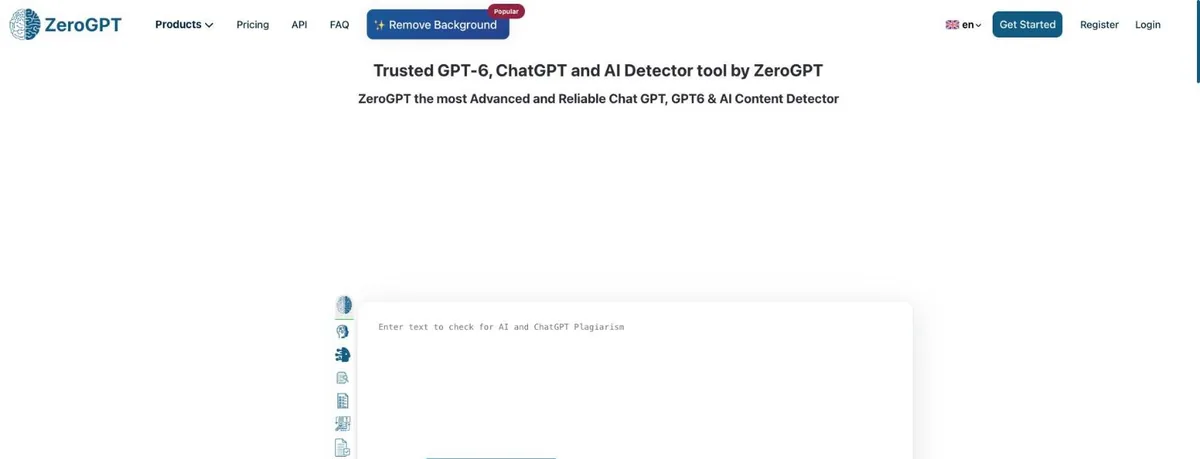
The site itself reads like a utility portal. The products menu runs to a humanizer, an image detector, a video detector, a paraphraser, a summarizer, a translator, a citation generator, a Pomodoro timer and the background remover in the screenshot. The headline claims detection of GPT-6, and the stats block claims 98.4 percent accuracy, a false-positive rate below 1 percent and coverage of 35-plus model families. None of those three figures links to a method.
What we read before scoring it
We did not run our own benchmark, for the same reason we never do: a few dozen samples measure those samples. Instead we collected every test we could trace to a named source, gave academic and journalistic tests more weight than vendor tests, and read rival detector companies' reviews only as labelled, interested evidence. We also read the privacy policy, tried to read the pricing page, and went through ZeroGPT's Trustpilot and Capterra profiles.
We expected the independent numbers to be scattered, and they are. What surprised us is that the two most careful sources, a peer-reviewed medical journal and a university benchmark, landed within a point of each other on the figure that matters most.
The false-positive record
A detector can be wrong in two directions. Missing a machine is an inconvenience. Calling a person a machine can cost them a grade, a contract or a reputation, which is why our detector rankings weight false positives above raw detection, and why ZeroGPT finishes last there.
| Source | What it found | Who ran it | Year |
|---|---|---|---|
| ZeroGPT homepage | 98.4% accuracy, under 1% false positives | Vendor claim | 2026 |
| Erol et al., Acta Neurochirurgica | About 94% sensitivity, about 16% false positives | Academic study, 250 human and 750 ChatGPT texts | 2025 |
| RAID benchmark (ACL) | Could not reach a 5% false-positive target; 16.9% overall at its strictest setting | University of Pennsylvania researchers | 2024 |
| Same RAID table, by domain | 29% news, 48% Wikipedia, 52% recipes | University of Pennsylvania researchers | 2024 |
| Scribbr comparison | 64% overall, one false positive | Scribbr (sells a rival detector) | GPT-4 era tests, revised 2026 |
| ZDNet five-text test | 5 of 5 correct | David Gewirtz | Oct 2025 |
The two academic sources measured different things in different ways and still agree: when ZeroGPT is set to catch AI, roughly one human text in six gets caught too. The RAID authors went further. Their method tunes each detector to wrongly flag no more than 5 percent of human text, and ZeroGPT is one of the tools marked as unable to get there. At its strictest threshold, per their domain table, it still flagged about half of the human-written recipes and Wikipedia-style passages. Formulaic writing is exactly what these models produce, so formulaic human writing gets punished. You can check the tables in the RAID paper.
We could confirm the Erol study's design from its published abstract but not read its full results tables, so treat the 94 and 16 as reported by secondary compilations. The RAID number we read ourselves.
Where it holds up
Fairness requires this section. Against long, untouched chatbot output, ZeroGPT does catch things. David Gewirtz's running ZDNet test, five short texts across two human and three ChatGPT samples, had ZeroGPT at a perfect five out of five in October 2025, up from four out of five earlier that year. The academic sensitivity figure of around 94 percent says the same thing in a larger sample. If you paste a raw ChatGPT answer in, it will very likely tell you it is AI.
That is the easy half of the job. Every serious detector manages it. The hard half is knowing when to say nothing, and five samples cannot test that. On marketing and narrative text the picture also wobbles: GPTZero, a rival with an obvious interest, published a 2026 test in which ZeroGPT scored one narrative AI passage at 29.9 percent AI.
The Declaration of Independence problem
In October 2024 Decrypt's Jason Nelson pasted the Declaration of Independence into several detectors. ZeroGPT called it 97.93 percent AI-generated. He then ran E.M. Forster's 1909 story "The Machine Stops" and a ChatGPT rewrite of it, and ZeroGPT scored the original as less human than the rewrite. Decrypt's write-up is worth reading in full if anyone has waved a ZeroGPT score at you.
Old, formal, carefully structured prose is statistically predictable, and predictability is what the classifier punishes. The same mechanism hits academic writing, legal drafting, and anyone writing in a second language. The 2023 Patterns study that found detectors flagging 61.3 percent of essays by non-native English speakers included ZeroGPT in its test group. It was not an outlier then, and nothing published since suggests it has fixed the problem.
Pricing you have to go looking for
When we loaded ZeroGPT's pricing page on October 7, 2026, it showed a free tier, Personal, Business/EDU and Enterprise tabs, a banner promising 40 percent off annual billing, and no dollar figures. The table below comes from third-party reviews, so treat it as a guide rather than a quote.
| Plan | Monthly (reported) | Characters per check | Source |
|---|---|---|---|
| Free | $0 | 15,000 | Vendor page, ad-supported, no account |
| Pro | $9.99 | 100,000 | GPTZero and Fast.io reviews, 2026 |
| Plus | $19.99 | 100,000 | GPTZero review, 2026 |
| Max | $26.99 | 150,000 | GPTZero and Fast.io reviews, 2026 |
| Expert | $69.99 | 350,000 | GPTZero review, 2026 |
| API | Pay as you go; reported $0.034 to $0.069 per 1,000 words | Vendor page (model), GPTZero (rates) | |
Annual pricing is murkier still. Capterra lists the Pro plan from $8.29 a month, which matches a $99.48 yearly figure Winston AI reported in 2024; the vendor's current 40 percent banner would put it nearer $6. We could not find a published refund policy. The WhatsApp and Telegram bots sit on the higher tiers, according to third-party reviews.
A worked example. A freelance editor checking 40 client articles a month at about 1,500 words each is looking at roughly 9,000 characters per article, which fits the free tier, so the monthly cost is $0 plus the adverts, or $9.99 for Pro if the ads become unbearable. The money is not the real cost. At a 16 percent false-positive rate, if every one of those 40 articles were genuinely human, about six a month would come back flagged. Each one is an awkward email to a writer who did nothing wrong.
The free tier, the ads and the humanizer on the same menu
The free check is generous on length. Fifteen thousand characters is around 2,500 words, twice what Scribbr or QuillBot allow per paste, and there is no account wall. The result shows a percentage and highlights the sentences it suspects; third-party testers describe that highlighting as imprecise, and we would not read much into which lines turn yellow. The page carries display advertising, which is how the free tier is paid for.
Two things about the wider site bother us more than the ads. First, the same menu that sells detection also sells an AI humanizer, a tool for making text pass detectors. GPTZero's new owner and QuillBot's parent have the same conflict, and we have said so in those reviews too; here it sits next to a false-positive claim the evidence contradicts. Second, the privacy policy says ZeroGPT does not give private user content to advertisers or use it to train models, which is good, and also notes that some advertising-identifier sharing may count as a "sale" or "sharing" under US state privacy laws. For a student essay that is a small concern. For unpublished research or client work under NDA, do not paste it into any free ad-funded detector.
If a teacher, editor or client has used ZeroGPT on your work, you are entitled to ask which tool and threshold they used, and to point them to the false-positive figures above. Export your Google Docs or Word version history, gather drafts and notes, and ask for a human read. A ZeroGPT percentage is not evidence of anything on its own.
What users report
Trustpilot is about as one-sided as review platforms get: 1.2 out of 5 from 109 reviews, 98 percent one-star, and a profile the company has not claimed. The complaints repeat almost word for word: original work flagged as AI, AI output passed as human, scores changing between runs, and nudges toward paid features.
This checker flagged my essay as 100% AI-written, while the essay the AI actually wrote was flagged as only 3% AI-written.Trustpilot reviewer, February 2026
Another reviewer, in August 2026, described a teacher running their essay through ZeroGPT, getting 55 percent AI, and the student insisting every word was their own. We cannot verify individual reviews, and a free tool attracts its angriest users to Trustpilot. Still, the pattern lines up with the academic data, which is the point at which we stop calling it anecdote. Capterra shows 4.0, but from only two reviews, which is too few to mean anything.
Bottom line. ZeroGPT's problem is not that it misses AI. It is that it finds AI in human writing often enough to hurt people, while advertising a false-positive rate the independent evidence does not come close to supporting.
Better free and cheap options
| ZeroGPT | GPTZero | Copyleaks | Scribbr | |
|---|---|---|---|---|
| Free allowance | 15,000 characters per check | 10,000 words/mo | About 10 pages/mo (unofficial) | 1,200 words per paste |
| Paid from | $9.99/mo (reported) | $14.99/mo, $8.33 annual | $16.99/mo | $19.95 per document |
| Independent false positives | About 16 to 17% | 1 to 12% | 1 to 2% | Not published |
| Prices shown on vendor page | No | Behind a toggle | Yes | Yes |
| Trustpilot | 1.2 | 2.2 | n/a | 4.3 (whole company) |
For a free tool that is less likely to accuse you, GPTZero gives you 10,000 words a month with sentence highlighting, and its own false-positive record, while uneven, is better. If your worst case is a wrong accusation, Copyleaks has the lowest false-positive figures we know of. For a quick no-signup check, Scribbr or QuillBot do the job without the ads.
Who should use it, if anyone
If you are curious whether a paragraph you already know came from ChatGPT will register as AI, ZeroGPT will tell you, for free, quickly. That is the full list of uses we are comfortable with.
Skip it if you teach, because a one-in-six false-positive rate across a class of 30 is five students wrongly suspected per assignment. Skip it if you edit or commission writing, because it will flag your best, most polished human writers. Skip it if you are a student checking your own essay, because a high score will frighten you for no reason and a low score proves nothing. And skip it if you write in English as a second language, since you are the group these tools fail most often.
Quick answers about ZeroGPT
Is ZeroGPT the same as GPTZero?
No. Different companies, different engines. ZeroGPT is run by Olive Works LLC, a Wyoming company; GPTZero belongs to Superhuman.
How accurate is ZeroGPT?
Good at catching plain chatbot text. Bad at leaving human writing alone: independent sources put false positives around 16 to 17 percent, against a claim under 1.
Is it free?
Yes, 15,000 characters per check with ads and no account. Paid plans exist, but the pricing page did not show prices when we checked.
Why did it flag my essay?
Formal, tidy, predictable prose looks machine-made to it. That is a known weakness, not proof you used AI.
Can my teacher use it against me?
They can, but they should not. Ask for a human read, show your version history and cite the published false-positive data.
Does ZeroGPT keep what I paste?
Its privacy policy says private text is kept only as long as needed and is not used for training. Ad identifiers may still be shared.
What should I use instead?
GPTZero for a bigger free tier, Copyleaks for the lowest false positives, Scribbr or QuillBot for a quick free check.
Why it sits at the bottom of our list
ZeroGPT is free, fast and good at the easy half of AI detection. It is poor at the half that protects people, it advertises a false-positive rate more than ten times better than two independent sources found, it hides its prices, and its users are almost unanimous in their anger. We would not use it to decide anything about anyone. If you want a free detector, there are three better ones linked above, and if someone has already used ZeroGPT against you, start with your version history.