 By
By A sensible free check for your own draft, sold with more authority than it has earned. The no-signup scanner, the four-way result labels and the plain privacy promise make it one of the easier detectors to recommend to a nervous student. The engine is borrowed from a sister brand, the free tier admits to "average accuracy" on older models, and the study Scribbr cites as proof was written by its own co-founder.
- Best for
- Students running a quick check on their own work before submitting
- Skip if
- You need to judge someone else's writing, scan long documents in one pass, or want audited accuracy
- Price
- Free up to 1,200 words; premium detection bundled with plagiarism checks from $19.95 per document
- Owner
- Learneo (Course Hero's parent), which also owns QuillBot
Who runs Scribbr, and whose engine is doing the work
Scribbr started in Amsterdam in 2012 as a thesis-editing business founded by Bas Swaen and Koen Driessen, and it grew into a network of more than 700 freelance editors plus a shelf of self-serve tools: citation generator, plagiarism checker, AI proofreader and, since the ChatGPT wave, an AI detector. Course Hero bought it in March 2022. Course Hero's parent now trades as Learneo, and its own 2023 press release lists eight business lines under one roof: CliffsNotes, Course Hero, bartleby, LanguageTool, LitCharts, QuillBot, Scribbr and Symbolab.
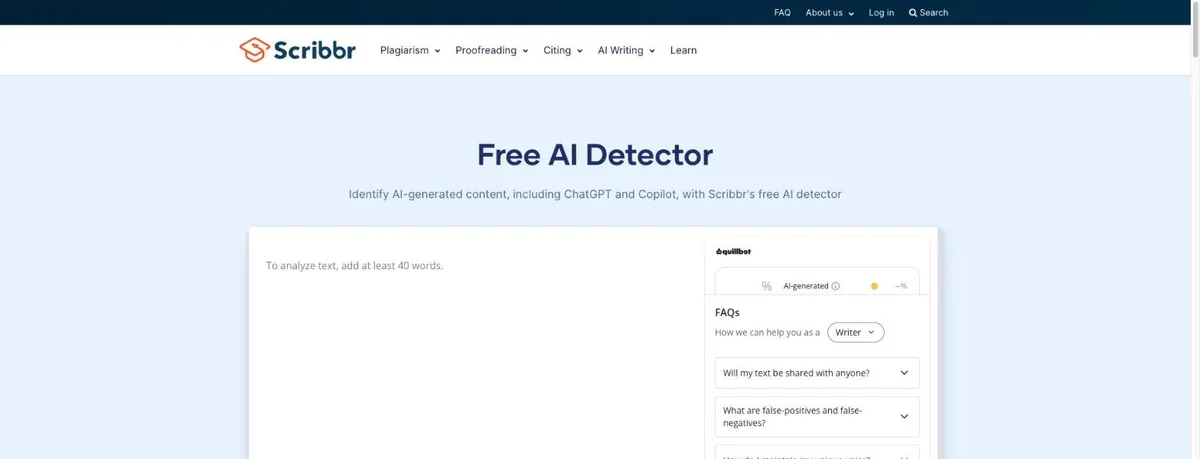
That family tree matters because the detector you paste into on scribbr.com is QuillBot's. The results panel carries a small QuillBot logo, and further down the page Scribbr suggests that QuillBot's own detector is "a more advance and reliable way" to check text, typo included. A few ranking reviews go further and describe Turnitin as part of the same group. It is not on Learneo's brand list, and we would not repeat that claim.
None of this makes the detector bad. It does mean that when you compare Scribbr against QuillBot you are mostly comparing two front doors to the same house, with different word limits, different language lists and different copy about which models are covered.
Sources we used, and the one we had to discount
We did not run a private benchmark. We read the vendor page and pricing on October 7, 2026, the Learneo and acquisition coverage, Scribbr's detector comparison, four of the review pages that currently rank for this tool, a ZDNet test series from 2025, and Scribbr's Trustpilot profile. Where a number comes from a company with something to sell, we say so.
The awkward source is the one everyone cites, including us on our detector hub. We have relied on Scribbr's comparison for a year as one of the few public tests with a published method. Reading it again for this review, line by line, we found reasons to lean on it less, and they are in their own section below.
Three ranking reviews are written by rival detector companies (GPTZero, Originality.ai and Quetext). We used their test results, labelled, because the alternative is having almost no third-party data at all. One other ranking page quotes a 600-sample benchmark and a per-model breakdown we could not trace to a primary source, so we left those figures out.
How well it spots AI text, and how often it accuses people
Start with what Scribbr itself says. The free version, according to its own page, detects GPT-2, GPT-3 and GPT-3.5 "with average accuracy". The premium version is said to detect GPT-4 with "high accuracy". That is unusually modest copy for this category and we give Scribbr credit for it, though it also tells you the free tier was described against models most people stopped using a long time ago. QuillBot's page, describing what appears to be the same engine, claims ongoing updates for GPT-5, Claude and Gemini. One of those two pages has not been edited in a while.
The output is better than a single percentage. Paragraphs are sorted into four labels: AI-generated, AI-generated and AI-refined, human-written and AI-refined, and human-written. For a student who wrote a draft and then ran it through a grammar tool, the "human-written and AI-refined" label is the honest answer, and most detectors cannot give it.
| Test | Result | Who ran it | Caveat |
|---|---|---|---|
| 30 texts, six categories | 78% free, 84% premium; 0 false positives | Scribbr | Vendor ranking its own tool |
| Four ChatGPT marketing texts | 0%, 0%, 0% and 95% AI | Originality.ai | Competitor; only one of four caught |
| Five texts, same QuillBot engine | 5 of 5 correct | ZDNet, David Gewirtz, Oct 2025 | Tiny sample; tested QuillBot's front end |
| Formal and mixed human writing | Flagged in some cases | Quetext | Competitor; no numbers published |
Read together, the evidence says the engine is good at long, unedited chatbot prose and much weaker on short commercial copy. Originality.ai's test is the most damaging, since three of four obviously machine-written marketing pieces came back as fully human. It is also run by a competitor, on four samples. On false positives, Scribbr's own test reported none, and nobody independent has published a large-sample human-text figure for this detector. That gap is why our hub lists its false-positive rate as "not published", and it is why we score caution with human writing in the middle rather than near the top.
Scribbr grading its own homework
This is the part the other reviews skip. Scribbr's comparison, the source behind the "premium 84 percent" figure quoted all over the internet, is bylined to Koen Driessen. He is Scribbr's co-founder. The article ranks Scribbr's premium detector first and Scribbr's free detector joint second, level with QuillBot, and it does not mention anywhere we could find that Scribbr's detector is QuillBot's engine or that both belong to Learneo. GPTZero, a direct rival, lands near the bottom at 52 percent.
The second problem is age. The article says it was revised on July 21, 2026, and the headline says 2026, but the test texts come from GPT-3.5 and GPT-4, and the results table still includes OpenAI's own AI Text Classifier, a tool OpenAI withdrew in 2023. Whatever was refreshed this summer, the underlying run is not a 2026 test of 2026 models.
There is also an internal inconsistency. The detector page still says the best free tool in Scribbr's research scored 68 percent; the study now says Scribbr's and QuillBot's free tools both scored 78. We have used 78 because it is what the current study states, and we have corrected our framing: the study is a well-documented vendor test, not an independent one. You can read Scribbr's comparison yourself and decide how much weight it carries.
What the free version actually gives you
Paste at least 40 words and up to 1,200, press the button, get a percentage and the paragraph labels. No account, no email, no daily cap that we could see on Scribbr's page, which is a quiet advantage over QuillBot's own front end, where the free detector stops at six scans a day and wants 80 words minimum. The flip side is languages: Scribbr lists English, Spanish, German and French, while QuillBot claims more than twenty.
Twelve hundred words is a short essay. A 3,000-word paper means three pastes, and you lose any sense of how the whole document reads, which matters because detectors are least reliable on short fragments. Our hub's warning applies here with force: independent compilations put accuracy on 50-word samples at 65 to 72 percent, against high 80s and low 90s above 250 words. Paste whole sections, not individual paragraphs, and do not panic over a single flagged block.
Paying for more: no subscription, just per-document bundles
There is no standalone paid AI detector. The premium detector arrives as part of Scribbr's plagiarism check, which is priced per document rather than per month. That is unusual, and for a student who needs one serious check a term it is arguably fairer than a subscription. Prices below are from Scribbr's plagiarism checker page as of October 7, 2026, in USD.
| Option | Price | Length | What you get |
|---|---|---|---|
| Free AI Detector | $0 | 40 to 1,200 words per submission | Score plus four paragraph labels; EN, ES, DE, FR |
| Plagiarism check, small | $19.95 per document | Up to 7,499 words | Full plagiarism report plus premium AI detection |
| Plagiarism check, regular | $29.95 per document | 7,500 to 49,999 words | Same, for dissertations and long reports |
| Plagiarism check, large | $39.95 per document | 50,000 words and up | Same, for theses and books |
A worked example. Take a second-year student writing four essays of about 2,500 words a term. On the free tier each essay is three pastes, so twelve checks a term at no cost. If that student wants the premium report on every essay, it is four small checks, $79.80 for the term. GPTZero's Essential plan for the same four months is $59.96 monthly, and its free tier alone covers 10,000 words a month, which handles all four essays without paying anything. Scribbr's bundle makes sense once, for a thesis: a 12,000-word dissertation falls in the $29.95 regular tier, and you get a plagiarism report you probably wanted anyway.
Scribbr's plagiarism FAQ says it will not refund customers who thought they were buying a subscription. Each check is a one-off purchase for one document. Read the size bands before paying, because a 7,600-word paper drops you into the $29.95 tier.
Privacy, data and the integrity question
Your submissions remain private; we do not store or share your data.Scribbr's claim on the AI Detector page, October 2026
That is a clear sentence and clearer than most rivals offer on their detector pages. It is still a claim; we have no way to audit it, and the text is processed by an engine run by a sister company. For a student essay we think the risk is low. For unpublished research or anything under embargo, we would not paste it into any free web detector, this one included.
The integrity point is simpler. Scribbr built this for students checking their own writing, and that is the only use we endorse. A lecturer who runs a student's essay through it and acts on the number is using a self-check tool as an accusation tool. The 2023 Patterns study, which found detectors flagging 61.3 percent of essays by non-native English speakers, did not test Scribbr, but nothing about this engine suggests it is immune to that pattern.
What users praise and what they complain about
Scribbr's Trustpilot profile shows 4.3 out of 5 from about 15,700 reviews, with replies to 88 percent of negative ones. Almost all of it concerns proofreading and editing orders, not the detector. The one-star themes are turnaround times that slipped past what was promised, support taking a couple of days to answer, a slow platform, and one long-time customer complaining that the service now feels like "AI slop". We found no Trustpilot reviews that discuss the detector specifically, which is normal for a free tool nobody pays for.
The detector's complaints live in the review pages instead, and they repeat: weak on marketing and narrative copy, uneven on mixed human-and-AI documents, and opaque about methodology. Students like that it is free and quick. Content teams mostly do not use it.
Worth using for
- No account, no email, no visible daily cap
- Four-way labels, including human-written and AI-refined
- Plain privacy promise on the page
- Pay-per-document premium, no subscription trap
- Modest, honest copy about free-tier limits
Not worth trusting for
- 1,200 words per paste; long papers get chopped
- Engine borrowed from QuillBot, not disclosed in the study
- Free tier described against GPT-3.5-era models
- Weak on short marketing copy in a competitor's test
- Only four languages
Scribbr against QuillBot, GPTZero and Copyleaks
| Scribbr | QuillBot | GPTZero | Copyleaks | |
|---|---|---|---|---|
| Free allowance | 1,200 words per paste, no signup | 1,200 words, 6 scans/day | 10,000 words/mo | About 10 pages/mo (unofficial) |
| Paid from | $19.95 per document | About $8.33/mo annual | $14.99/mo, $8.33 annual | $16.99/mo |
| Score in Scribbr's study | 84% premium, 78% free | 78% | 52% | 66% |
| Independent false positives | Not published | Not published | 1 to 12% | 1 to 2% |
| Languages | 4 | 20+ | Multiple | 30+ |
| Best for | Self-checks | Quick daily checks | Educators | Low false positives |
If you want the same engine with more languages, use QuillBot directly; our QuillBot AI Detector review covers its limits. If you want a bigger free allowance and sentence-level highlighting, GPTZero wins on the free tier alone. If you are worried about being wrongly flagged, Copyleaks has the cleanest false-positive record in independent tables. And if the free detector you were about to use is ZeroGPT, read our ZeroGPT review first.
Who it suits, and who should look elsewhere
Use it if you are a student who wants to see how your own draft scores before a lecturer runs something on it, and you would rather not create another account. It is also reasonable for a quick look at a short article in English, Spanish, German or French. Keep the result with your version history; it shows you checked.
Look elsewhere if you are judging anyone else's work, if you publish for a living and need team features or paraphrase detection (Originality.ai is built for that), if your documents run to many thousands of words, or if you need a language beyond the four listed. And if you have been flagged by some other detector, Scribbr's score will not clear your name. Version history, drafts and a conversation with your instructor will.
Short answers about Scribbr's detector
Is Scribbr's AI detector free?
Yes. Up to 1,200 words per submission, at least 40 words, no account. The premium detector only comes bundled with a paid plagiarism check.
Is it just QuillBot?
In practice, yes. The results panel carries QuillBot branding and both brands belong to Learneo, the company behind Course Hero.
How accurate is it?
Scribbr's own study says 78 percent free and 84 percent premium. Independent tests are thinner and less kind, especially on marketing copy.
Does Scribbr keep my text?
Scribbr says it does not store or share detector submissions. That is a vendor claim we could not test.
What does the premium version cost?
There is no subscription. It comes with the plagiarism checker at $19.95, $29.95 or $39.95 per document, depending on length.
Can a teacher rely on it?
No. It is built for students checking their own work. Nobody should be accused on the strength of one detector score.
Is Scribbr's detector study trustworthy?
Useful, but not neutral. Scribbr's co-founder wrote it, Scribbr's own tool comes first, and the test texts date from the GPT-3.5 and GPT-4 era.
Where we land on Scribbr
As a free self-check, Scribbr's detector is fine, and in a couple of small ways, the no-signup flow and the "human-written and AI-refined" label, it is kinder to students than most. As evidence about anyone else's writing it is no better than the QuillBot engine underneath it, and the company's habit of citing its own co-founder's study as if it were neutral research costs it points it did not need to lose. Use it to check your draft, keep your version history, and give the 84 percent figure the weight you would give any vendor's number about itself.