 By
By The safest detector to point at a human being, and one of the most annoying to budget for. Independent testers keep finding that Copyleaks rarely calls human writing AI, which is the property that matters most when a grade or a job is on the line. It is weaker on edited and humanized text, the free allowance is hidden, and the unified-credit pricing turns a simple question into arithmetic.
- Best for
- Teachers, schools and compliance teams who fear a false accusation more than a miss
- Skip if
- You publish at volume, you need to catch humanized copy, or you want a usable free tier
- Price
- $16.99/mo (25,000 words), or $13.99/mo billed annually
- Trustpilot
- 2.5 from 345 reviews
Who makes Copyleaks, and what you actually get
Copyleaks is older than the AI detection boom. Alon Yamin and Yehonatan Bitton, who met in the Israeli army's 8200 intelligence unit, started it in 2015 as a plagiarism checker, with the main office in New York and development in Kiryat Shmona, Israel. It raised a $1.8 million seed round led by Connecticut Innovations and a $6 million Series A led by JAL Ventures in 2022, which is modest money by AI standards. Calcalist reported a staff of about 20 at the time. The company now claims 30 million scans a month and more than 500 enterprise and education customers. Those are its figures, not audited ones.
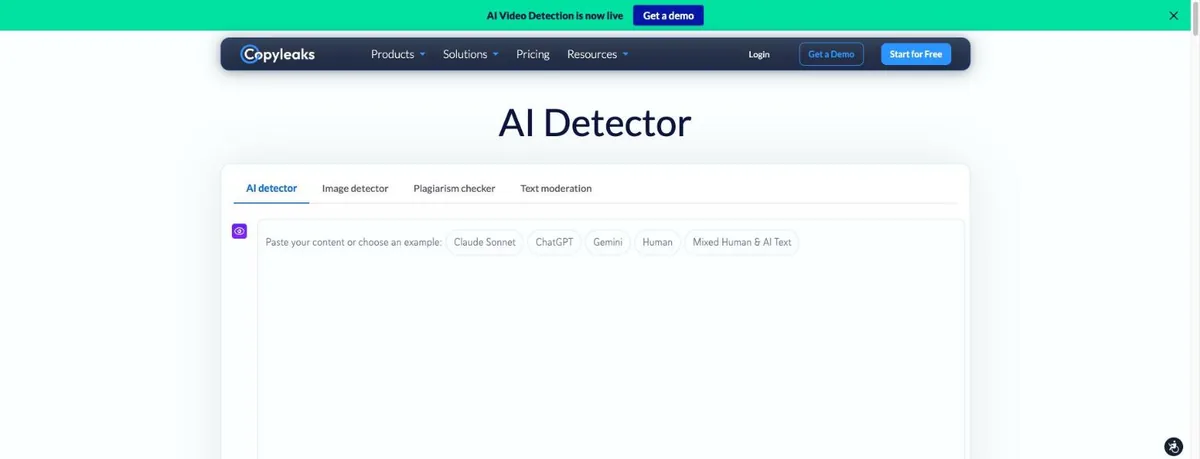
The product today is a suite. The AI text detector is the reason most people arrive, but the same dashboard runs the plagiarism checker (the original business, covering 100-plus languages), an AI image detector, a newly launched AI video detector, a grammar checker and a text moderation tool. AI detection itself is claimed for 30-plus languages. Teachers get LMS plug-ins for Canvas, Moodle, Blackboard, D2L and Schoology, there is a Chrome extension and a Google Docs add-on, and developers get an API. The homepage lists SOC 2, SOC 3, GDPR and PCI DSS compliance. It does not mention FERPA, which American schools will want in writing before signing.
The report is the part teachers tend to like. You get a single document score, sentence-level highlighting, and, if you run both checks, AI and plagiarism results side by side. That combination is the real competitive edge here. GPTZero has a plagiarism checker too, but Copyleaks has been doing plagiarism for a decade longer and it shows in the source matching.
Where our numbers come from
We did not run a private benchmark. A few dozen essays tells you about those essays, and the published research on Copyleaks is unusually deep for this category, so we used it. We read the Walters study in Open Information Science, Bloomberg's 2024 false-positive test, Scribbr's comparison (last revised July 2026), and the list of academic papers Copyleaks itself promotes, which we treat as vendor-curated because it is. We read the pricing page and the detector page on October 7, 2026, worked through the credit conversions by hand, read 345 Trustpilot reviews by theme and the Capterra summary, and checked what universities that deploy Copyleaks tell their own students about data storage.
We spent longer than we would like to admit on the pricing page toggle. The labels and the figures did not obviously line up on first read, which is itself a finding.
Accuracy: a cautious classifier with a split record
Copyleaks claims "over 99% accuracy". Treat that as marketing until you see who measured it. The independent record is better than for most detectors, and it is also more mixed than the vendor admits.
| Test | What was tested | Copyleaks result | Who ran it | Year |
|---|---|---|---|---|
| Comparison of 16 detectors | 126 documents: GPT-3.5, GPT-4, student essays | One of three with high accuracy on all three sets | William H. Walters, Open Information Science | 2023 |
| False-positive test | 500 Texas A&M application essays written before ChatGPT | 1 to 2% wrongly flagged (with GPTZero) | Bloomberg (Davalos, Yin) | 2024 |
| Scribbr comparison | 30 texts: human, GPT-3.5, GPT-4, mixed, paraphrased | 66% overall, no false positives | Scribbr (sells a competing detector) | Revised July 2026 |
| Vendor accuracy claim | Not published as a dataset | Over 99% | Copyleaks | 2026 |
| Vendor false-positive claim | Not published as a dataset | 0.03% | Copyleaks | 2026 |
The Walters paper is the strongest single piece of evidence in the company's favour. It is peer reviewed, it tested 16 detectors on the same 126 documents, and Copyleaks was one of only three that held up on GPT-4 output as well as on GPT-3.5 and genuine student work. Most of the other 13 could handle the older model and fell apart on the newer one.
Scribbr's test pulls the other way, and the reason is in the sample. Scribbr deliberately included paraphrased and mixed human-and-AI texts, and on those Copyleaks often said "human". Its 66 percent overall comes almost entirely from misses, not false accusations: it flagged none of Scribbr's human texts. That is the profile in one sentence. When Copyleaks is unsure, it leans towards innocent.
Two smaller observations. The vendor's own false-positive claim has drifted: 2024 reviews quoted 0.2 percent from Copyleaks marketing, and the detector page now says 0.03 percent. Neither comes with a published dataset. And the academic papers on Copyleaks's own "third-party validation" page are real, but a vendor choosing which studies to show you is still a vendor. We have cited only the ones we could read ourselves.
False positives, the number that matters most
A detector that misses some AI text costs a publisher a little embarrassment. A detector that flags a student who wrote every word costs that student a misconduct hearing. This is why we rank false positives above raw detection, and it is the one area where Copyleaks has a genuine, independently measured lead.
Bloomberg's 2024 test is the cleanest evidence anyone has published on this. Reporters ran 500 Texas A&M application essays from summer 2022, before ChatGPT existed, through Copyleaks and GPTZero. Both wrongly flagged 1 to 2 percent of them, in some cases with near 100 percent confidence. That is low for the category. It is also not zero, and a school running 2,000 essays through the tool in a term should expect somewhere between 20 and 40 wrongful flags if that rate holds. The vendor's 0.03 percent would mean less than one.
"My quality of writing is being flagged for 100% Ai generated work."Jacob, Trustpilot, July 29, 2026
On Capterra, a history teacher describes running a piece written five years before ChatGPT and getting 65 percent AI back. Individual stories like these appear on every detector's review pages, Copyleaks included. They do not contradict the Bloomberg number. A rate of one or two in a hundred still means someone gets the wrong answer, and the 2023 Patterns study on non-native English writers is a reminder that formal, careful prose is the kind most at risk. Our position is simple: a Copyleaks score should start a conversation with the writer, never end one.
Pricing: what a credit is and what it really costs
Copyleaks sells "unified credits". One credit covers 250 words of text or one image, and the same pool is shared across AI detection and plagiarism. That is flexible on paper and hard to reason about in practice, because the pricing page leads with credits and images rather than words per month. Here are the figures as of October 7, 2026.
| Plan | Billed monthly | Billed annually (per month) | Annual total | Credits | Words | Seats |
|---|---|---|---|---|---|---|
| Personal | $16.99 | $13.99 | $167.88 | 100/mo; 1,200 on annual | 25,000/mo; 300,000 on annual | 1 |
| Pro | $99.99 | $74.99 | $899.88 | 1,000/mo; 12,000 on annual | 250,000/mo; 3,000,000 on annual | 25 |
| Enterprise / Education | Custom quote | Custom | Role-based, SSO | |||
Notice that annual billing does not buy you more words. It buys you twelve months of the same allowance for about 18 percent less on Personal and 25 percent less on Pro. Extra credits can be bought on the platform, but the per-credit price is not on the pricing page. We could not confirm from the pricing page whether running AI detection and plagiarism on the same document draws credits twice, so assume it might.
A worked example, because this is where the credit system bites. A freelance editor checking client drafts, about 20,000 words a month, fits the monthly Personal plan with room to spare: $16.99, or roughly 85 cents per thousand words. On annual billing the same editor pays $167.88 a year. A secondary-school English teacher with five classes of 25 is a different story. One 1,000-word essay per student per month is 125,000 words, five times the Personal allowance. The realistic options are Pro at $99.99 a month, buying top-up credits at a price you only see after logging in, or getting the school to buy an education licence. In practice the third is how most teachers end up on Copyleaks, and it is why the individual pricing feels designed for people who will not use it much.
The free allowance nobody advertises
The pricing page shows no free plan at all. The detector page, by contrast, says you can scan up to 25,000 characters for free, "more than any other major AI detector", and that a free account unlocks "more monthly credits". It does not say how many. Third-party reviewers in 2026 report roughly 10 pages a month on a free account with lower processing priority, and Unite.ai's earlier review counted five free credits on sign-up. Both are small, and neither is a figure the company commits to in writing.
In practice the anonymous scan box is the useful part. Paste a single essay or article, read the sentence highlighting, and decide whether the report style suits you. If you want to run a whole term's work through a free tool, GPTZero's 10,000 words a month is the better deal, as our GPTZero review explains.
Privacy: what happens to the work you upload
This is the question most Copyleaks reviews skip, and for schools it should come first. Copyleaks is a plagiarism company, and plagiarism checkers work by comparing new submissions against old ones. In an institutional deployment that usually means storing student work in an internal repository so that next year's essays can be checked against this year's.
Southern Methodist University's Copyleaks FAQ tells students that "submissions cannot be removed once added to the internal database." That is a statement about SMU's configuration, not every account, but it is the default to ask about. If you are uploading unpublished research, client work or anything confidential, check the repository settings first.
On the security side the picture is reassuring. The company lists SOC 2 and SOC 3 reports, GDPR compliance and PCI DSS for payments, enterprise plans offer flexible data hosting, and we found no breach, regulator action or lawsuit naming Copyleaks. The open question is FERPA, which matters to US schools and which Copyleaks does not claim on its homepage. Ask the sales team for the paperwork.
What users complain about
Trustpilot sits at 2.5 out of 5 from 345 reviews, and it is a split page: 50 percent one-star, 41 percent five-star, almost nothing between. The one-stars fall into two piles. The bigger one is people whose own writing was flagged, often students and often furious, with lines like "it always gives either 0% or 100% AI content even for paragraphs I wrote myself" (August 2026). The second pile is about money: auto-renewal charges and slow support, summed up by one July 2026 reviewer as "auto charging me and no available customer service". The five-stars praise the reports and, interestingly, the support team. Copyleaks has replied to 66 percent of negative reviews, which is a long way better than GPTZero's silence.
Capterra paints a calmer picture at 4.4 from 91 reviews, mostly from educators and writers who pay for it. The recurring complaints there are the credit system being confusing for occasional users, cost for students, and the same document scoring differently on separate scans. That last one deserves attention. A detector whose answer changes when you press the button twice is giving you a probability, not a verdict.
Copyleaks against GPTZero, Winston AI and Originality.ai
| Copyleaks | GPTZero | Winston AI | Originality.ai | |
|---|---|---|---|---|
| Paid from (monthly) | $16.99 | $14.99 | $18 | $14.95 |
| Free access | Scan box, small account allowance | 10,000 words/mo | 14-day trial, 2,000 credits | 60 credits/mo |
| Independent false positives | 1 to 2% (Bloomberg) | 1 to 12% | Not independently published | 4.8 to 5.7% |
| Catches paraphrased text | Weak | Mixed | Not independently tested | Strongest on RAID |
| Plagiarism included | Yes, 100+ languages | Yes | Yes | Yes |
| Education integrations | Canvas, Moodle, Blackboard, D2L, Schoology | Canvas and other LMSs | Google Classroom | Not education-focused |
| Trustpilot | 2.5 | 2.2 | 3.8 (28 reviews) | 4.6 |
If false accusations are your main fear, Copyleaks is the pick of the four. If you want the most usable free tier, it is GPTZero. If you need to scan paper or handwriting, see our Winston AI review. And if you are an agency trying to catch freelancers who run AI copy through a humanizer, Originality.ai is the better tool, because that is exactly the case where Copyleaks's caution lets text through. Our full detector comparison ranks all eight.
Who it suits, and who should look elsewhere
Reasons to pay for it
- Lowest independently measured false-positive rate we track
- Peer-reviewed results on unedited GPT-4 text
- A decade of plagiarism detection in the same report
- Five LMS integrations, API, Chrome and Docs add-ons
- SOC 2 and SOC 3, GDPR, no incidents found
- Answers most of its negative reviews
Reasons to hesitate
- Misses more edited and humanized text than rivals
- 25,000 words a month on Personal is tight
- Credit system needs a calculator
- Free allowance unstated and small
- Institutional repositories may keep your work
- Vendor accuracy claims have no published dataset
Use Copyleaks if you are a teacher, a school, or a compliance team, and the worst outcome for you is accusing someone who did nothing wrong. It also suits multilingual institutions, since the language coverage is broad, and anyone who wants plagiarism and AI results in a single report. Skip it if you are a content agency trying to catch humanized freelancer copy (Originality.ai), a student who wants to check essays for free (GPTZero), a solo writer processing more than 25,000 words a month who does not want to pay Pro prices, or anyone uploading confidential material without first finding out where it will be stored.
Questions readers ask about Copyleaks
Is Copyleaks accurate?
On long, unedited AI text, usually. A 2023 peer-reviewed comparison put it among the best three of 16 detectors. Scribbr's mixed and paraphrased test scored it 66 percent.
How often does it flag human writing?
Rarely, on the evidence. Bloomberg's 2024 test of 500 pre-ChatGPT essays found 1 to 2 percent flagged. The vendor's 0.03 percent claim is lower than any independent figure.
What does it cost?
Personal is $16.99 a month for 25,000 words, or $13.99 a month billed annually. Pro is $99.99 monthly or $74.99 on annual, with 25 seats.
Is there a free version?
A free scan box on the detector page and a few credits with a free account. The pricing page lists no free plan.
What is a credit?
250 words of text, or one image. Monthly Personal gives you 100.
Does it keep my text?
Institutional setups can store submissions for comparison, and at least one university says they cannot be removed once added. Ask before you upload.
Can it catch humanized text?
Less reliably. Independent reviewers report it misses aggressively rewritten or humanized text, like every detector we track.
Verdict
Copyleaks is the detector we would least mind being run on our own writing. The peer-reviewed results on unedited text are good, the independent false-positive evidence is the best in the category, and the plagiarism heritage makes its combined report genuinely useful in a classroom. The weaknesses are commercial rather than technical: a free tier you have to hunt for, a credit system that hides how few words the cheap plan buys, and a habit of quoting accuracy figures nobody else can reproduce.
Bottom line. Buy it through your institution if you teach, test the free scan box if you are curious, and look at Originality.ai instead if your problem is humanized copy rather than wrongful accusations.
At $16.99 for 25,000 words, a solo buyer should be sure they need the caution before they pay for it.