 By
By The detector we would use first and trust least on its own. No sign-up, six 1,200-word scans a day and an unusually candid results page make it the easiest free check in the category. Its best accuracy number comes from a sister company, the independent evidence is thin and mixed, and the same subscription that unlocks it also unlocks a humanizer.
- Best for
- Writers and students checking their own drafts before submission
- Skip if
- You need audit-grade evidence, an API, or a detector that is not sold alongside a humanizer
- Price
- Free (6 scans/day, 1,200 words each); Premium $19.95/mo or $8.33/mo annual
- Trustpilot
- 4.8 from 14,316 reviews, for QuillBot as a whole
A detector bolted onto a paraphraser
QuillBot started in 2017 as a dorm-room paraphrasing project by Anil Jason, Rohan Gupta and David Silin, and it is still best known for rewriting other people's sentences. In 2021 it became part of Course Hero's group, which renamed itself Learneo in December 2022. The same parent owns Scribbr, CliffsNotes, LitCharts, Symbolab and, since 2023, LanguageTool. QuillBot's own about page claims more than 35 million monthly active writers and about 225 staff.
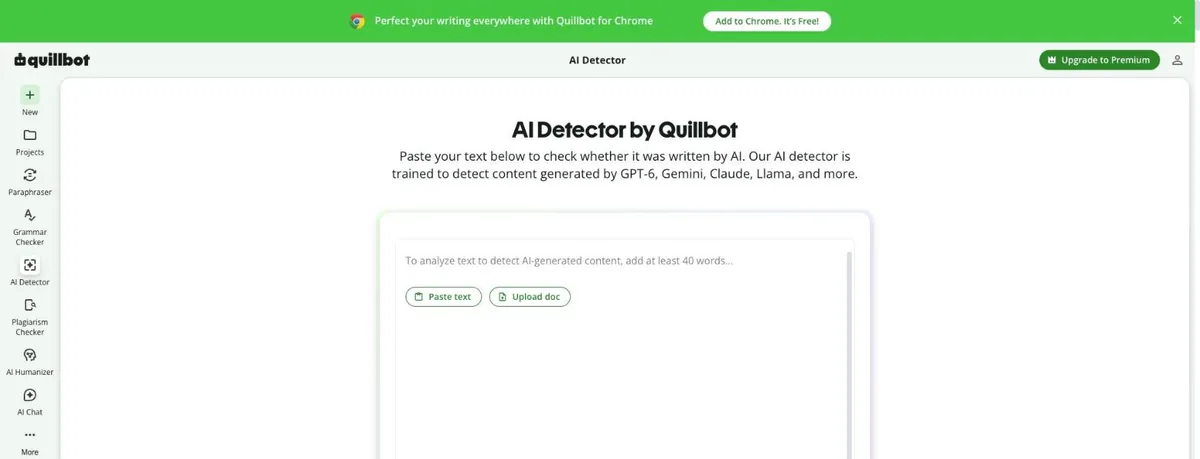
The detector is one tab in that sidebar. You paste text or upload a document, and it returns an overall percentage plus a line-by-line breakdown that separates text it thinks was AI-generated from text it thinks was human-written and then refined with AI. That second bucket is more honest than most detectors manage, because it admits the real world is mostly mixed drafts rather than pure machine output.
One small inconsistency we noticed on October 7: the empty text box asks for "at least 40 words", while the product page says it needs 80 words to score reliably and works best above 300. Believe the larger numbers. Short text is where every detector falls apart.
Where our evidence comes from, and why one source gets an asterisk
We did not run a private benchmark. A few dozen samples run by one reviewer tells you about those samples, and we would rather show you who tested what. For this review we read QuillBot's detector page, pricing page and trust centre, the four review pages that currently rank for this tool, every independent test we could trace to a named author and date, Trustpilot and Capterra, and the corporate filings and press releases that explain who owns whom.
That last step changed the review. Almost every article about QuillBot's detector, including our own detector comparison until today, leans on Scribbr's study, which ranks QuillBot second of twelve. Scribbr is not a neutral lab. Course Hero bought it in March 2022, it sits under Learneo with QuillBot, and Scribbr's own free detector is labelled as powered by QuillBot. The study is published with its method and it may well be fair, but it is a sister company grading a sibling.
We nearly kept calling the Scribbr result independent, because everyone else does and because the methodology is genuinely open. Then we read the Learneo brand list. Openness of method and independence of the tester are different things, and readers deserve both facts.
Accuracy and false positives, by who ran the test
| Source | Result | Sample | Who ran it |
|---|---|---|---|
| RAID benchmark | 99% detection | Not stated on the page | Claimed by QuillBot |
| Scribbr comparison (revised July 2026) | 78% accuracy, 0 false positives | 30 texts, 6 categories | Scribbr, a Learneo sister company |
| ZDNet detector round-up (Oct 2025) | 5 of 5 correct | 2 human, 3 ChatGPT texts | David Gewirtz, ZDNet |
| FHNW bachelor thesis (2026) | 16.3% and 39% AI on AI versions | 1 paper, 2 AI rewrites | Piracintha Alfred, FHNW |
"99% detection rate, according to independent evaluations from RAID." QuillBot's AI Detector page, October 7, 2026
That is the vendor's claim, and RAID is a respected academic benchmark, but QuillBot does not show which RAID subsets or settings produced the figure. Read the sample column of the table before the result column. The cleanest results come from tiny tests on clean, unedited chatbot output, which is the easy case. ZDNet's David Gewirtz gave QuillBot a perfect score in October 2025 and noted that earlier inconsistencies had gone, but five texts is five texts. Scribbr's 30-text study is larger and covers the hard categories, including human text that was mixed with GPT-3.5 and text paraphrased by, of all tools, QuillBot.
The result that should worry an instructor is the smallest and most realistic one. A 2026 bachelor thesis at the University of Applied Sciences and Arts Northwestern Switzerland (FHNW) took one real student paper, produced two AI versions of it, and ran all three through Turnitin, GPTZero, Originality.ai and QuillBot. QuillBot was the weakest of the four, scoring the AI versions at only 16.3 and 39 percent AI. One paper proves nothing on its own. It does match the pattern every serious detector study finds: rewritten, domain-specific academic text slips through.
False positives look good in what little data exists. Scribbr recorded none on its five human texts, ZDNet none on two. That is seven human samples in total, which is not a false-positive rate, it is an anecdote. QuillBot itself warns that heavily paraphrased or formulaic human writing, such as legal copy or academic definitions, can be over-flagged, and the 2023 Patterns study showing detectors flagging 61.3 percent of non-native English essays applies to this class of tool as a whole. If English is your second language, keep your drafts.
QuillBot's own page says it plainly: "Scores are signals, not verdicts. Never make an academic or employment decision on a detector score alone." If your school is using a QuillBot screenshot as the basis of a misconduct case, quote that sentence back to them.
The humanizer problem nobody puts in the headline
The same Premium subscription that removes the detector's limits also unlocks QuillBot's paraphraser in nine modes and its AI Humanizer, a tool whose stated purpose is to make AI text read as human. You can check a draft, see a high AI score, click two icons down the sidebar, and rewrite it. We are not suggesting the detector is rigged. We are saying the company earns money on both sides of the score, and a buyer making an institutional decision should weigh that.
It also creates an obvious question nobody has answered with data: does QuillBot's detector catch QuillBot's humanizer? We could not find a single independent test of that exact pairing. Scribbr's study tested QuillBot's paraphraser, not the humanizer, and Scribbr shares the owner. If you are curious about the other side of this market, our humanizer guide covers what those tools actually do to detector scores.
What Premium costs, and when it is worth paying
There is one paid plan for individuals, called Premium, sold on three billing cycles. The figures below are as of October 7, 2026. The pricing page we loaded showed only the annual figure by default, so the monthly and quarterly prices come from Hackceleration's June 2026 pricing tracker and match the other trackers we checked. Confirm on the live page before you pay.
| Plan | Billed | Per month | Detector limits | Also includes |
|---|---|---|---|---|
| Free | $0 | $0 | 1,200 words per scan, 6 scans a day, 1 explainer card | Paraphrase and humanize up to 100 words |
| Premium monthly | $19.95 | $19.95 | Unlimited | Paraphraser, humanizer, 25,000 plagiarism words/mo |
| Premium quarterly | $39.95 | $13.32 | Unlimited | Same |
| Premium annual | $99.95 | $8.33 | Unlimited | Same |
| Team | Per seat, not shown on the page we loaded | Unlimited | Admin dashboard, no training on inputs | |
Here is how that plays out for a real person. Take a secondary-school teacher with 120 essays of about 1,000 words at the end of each term, three terms a year. On the free tier that is 120 scans at six a day, so 20 days of pasting for one marking load, which nobody will do. Premium monthly for the three marking months costs $59.85 a year if you remember to cancel each time. Quarterly, bought three times, is $119.85. Annual is $99.95 and needs no calendar reminders. For a teacher who marks in bursts, three single months is the cheapest route, and the annual plan only wins if you also use the paraphraser or grammar tools between terms.
A freelance writer checking ten 1,500-word articles a month needs nothing at all. Split each article into two scans and you use 20 scans spread across a month, well inside the free cap. Paying for the detector alone, in that case, is paying for convenience.
On refunds, the pricing page we loaded said nothing. Third-party trackers report a three-day money-back guarantee on new Premium subscriptions, and Trustpilot's billing complaints are mostly about renewals that arrived at a higher price than the first year. One Trustpilot reviewer described a renewal of €99.95 landing after a first year at €59.95, with no warning they noticed, so put the renewal date in your calendar the day you subscribe.
The free plan is the product
For most people reading this, the free tier is all they will ever use, and it is genuinely good. No account, no email, no card. Six scans a day at up to 1,200 words each is 7,200 words of checking daily, and the cap resets rather than running out for the month like GPTZero's 10,000-word allowance. The trade is depth: you get one explainer card, which tells you why a single passage looked machine-written, instead of the full breakdown.
That is enough for a student checking a final draft at midnight, which is exactly who uses it. It is not enough for a teacher with a stack of essays, and it is not built for an editor running a site.
Privacy, data and the training setting
Anything you paste is processed on QuillBot's servers, and the default for individual users is that inputs may be stored and used to improve its models. QuillBot's trust centre says users can switch off both storage and training (the browser extension exposes this under Data and Privacy from version 4.37.0), that it does not train on any text from Team plan users, and that it does not let third-party providers train on your data. It lists GDPR, CCPA, the EU-US Data Privacy Framework, PCI DSS and a CASA Tier 2 assessment. It does not list SOC 2 or FERPA, which matters if you are a school procurement office rather than an individual. GPTZero has both; see our GPTZero review.
Our practical advice: if you are pasting a student's work, a client's draft or anything under NDA, turn the training setting off first, or use the Team plan.
What users complain about
Trustpilot rates QuillBot 4.8 out of 5 from 14,316 reviews, with 87 percent five-star and 3 percent one-star, and the company replied to every negative review in the last year. That score covers the whole product and most of it is about the paraphraser, so treat it as a verdict on the company rather than the detector. Capterra's 157 reviewers give 4.5.
The negative themes repeat across both sites. Renewals that arrive without warning, sometimes at a higher price than the first year. A refund policy one Capterra reviewer called inflexible, with no prorating. Support that is slow on billing questions. And, specifically on the detector, scores that do not match the user's own knowledge of how a text was written, including one reviewer who quoted a "54% of your text are not AI generated" result on writing they knew the origin of.
None of that is unusual for the category. The difference from GPTZero is that QuillBot answers its critics in public, which is a low bar it clears.
QuillBot vs GPTZero vs Sapling vs Scribbr
| QuillBot | GPTZero | Sapling | Scribbr | |
|---|---|---|---|---|
| Free check | 1,200 words, 6/day, no account | 10,000 words/mo | 2,000 characters | 1,200 words |
| Paid from | $19.95/mo; $8.33 annual | $14.99/mo; $8.33 annual | $25/mo; $12 annual | Premium via Scribbr |
| Scribbr study accuracy | 78% | 52% | 68% | 78% free, 84% premium |
| Sentence-level view | Yes, limited on free | Yes | Yes | Yes |
| API | None advertised | Professional tier | Usage-based, $5 minimum | No |
| Sells a humanizer too | Yes | Owner does | No | Sister company does |
The Scribbr column is the tell. Scribbr's free and premium detectors and QuillBot share a parent, and the free one shares an engine, so treat the two as one product with two front doors. If you want a second opinion from a genuinely different model, use GPTZero's free tier or Sapling's. Our Sapling review covers the developer angle, where it is the cheaper choice.
Who it suits, and who should look elsewhere
Reasons to keep it bookmarked
- No-account free tier with a daily reset
- Separates AI-generated from AI-refined lines
- Honest warnings printed on its own page
- 20-plus languages
- Training opt-out and no training on Team inputs
- Responsive on Trustpilot
Reasons not to rely on it
- Best test result comes from a sister company
- Weakest of four in a 2026 academic-paper test
- Premium bundles a humanizer with the detector
- No SOC 2 or FERPA listed
- No detector API
- Renewal and refund complaints
Students checking their own work should use it, ideally alongside one detector from a different company, and keep version history regardless of the score. Writers and bloggers who want reassurance before sending a draft to a client will get it free. Teachers can use it for a first look, but the free caps and the missing education certifications push them towards GPTZero. Publishers and agencies should buy Originality.ai instead. Anyone who needs to make a decision about another person should not rely on this tool alone, and QuillBot says so itself.
Questions readers ask about QuillBot's detector
Is it really free?
Yes. Six scans a day, up to 1,200 words each, no account needed. Premium removes the caps.
How accurate is it?
Good on long, unedited AI text. Weak on edited or mixed drafts: a 2026 Swiss thesis saw it score AI versions of a paper at 16.3 and 39 percent.
Is Scribbr's test of it independent?
No. Scribbr and QuillBot share a parent company, Learneo, and Scribbr's own detector runs on QuillBot's model.
What does Premium cost?
$19.95 a month, $39.95 a quarter or $99.95 a year as of October 7, 2026. It bundles the paraphraser, humanizer and plagiarism checker.
Does it keep my text?
It can. Individual users get settings to stop storage and model training. QuillBot says it does not train on Team plan inputs.
Should a teacher use it as proof?
No. QuillBot's own page says scores are signals, not verdicts. Pair it with version history and a conversation.
Can it detect QuillBot's own humanizer?
Not reliably, and nobody independent has published a clean test of that pairing.
Verdict
QuillBot's AI detector is the free check we would reach for first: no account, a daily reset, a candid results page and a reasonable record on clean AI text. It loses points for evidence that leans on a sister company, a weak showing on a real academic paper, and a Premium plan that sells detection and evasion in the same bundle. Use it for free, as a first look at your own writing. If you need to pay for a detector, pay for one whose owner is not also selling the way around it.