 By
By A sensible tool for short text, sold under the most aggressive data terms in the category. Two to five variations per run, a free image detector and MCP access on the upper plans make WriteHuman useful for captions, abstracts and email openers. The per-request word caps make it awkward for anything long, the detector results collapse on longer text, and the terms give the company a perpetual right to train on your input.
- Best for
- Social and marketing teams humanizing short, non-confidential copy
- Skip if
- You write long-form, you handle client or unpublished material, or you want a refund option
- Price
- $20/mo, or $12/mo billed annually, for 80 requests of 600 words
- Trustpilot
- 4.0 from 307 reviews
Who makes it, and what it does
WriteHuman is one of the few humanizers with a traceable origin story. Ivan Jackson, a James Madison University graduate, launched the site from Midlothian, Virginia in July 2023 and started charging subscriptions that August, according to a February 2024 profile in Richmond BizSense. At that point he had spent a little over $6,000 on advertising and hosting, ran it alone alongside a day job, and reported 200,000 monthly users with fewer than 2,000 paying. The business was profitable, and it went on to take $20,000 of equity-free funding through the Lighthouse Labs accelerator in Richmond.
Two and a half years later the operation is bigger. WriteHuman LLC now ships a web app, a Chrome extension, iOS and Android apps, a developer API and an MCP server, and the homepage claims 7.5 million documents humanized and support for more than 40 languages. Those are vendor figures. We could not find any later funding round or a current headcount.
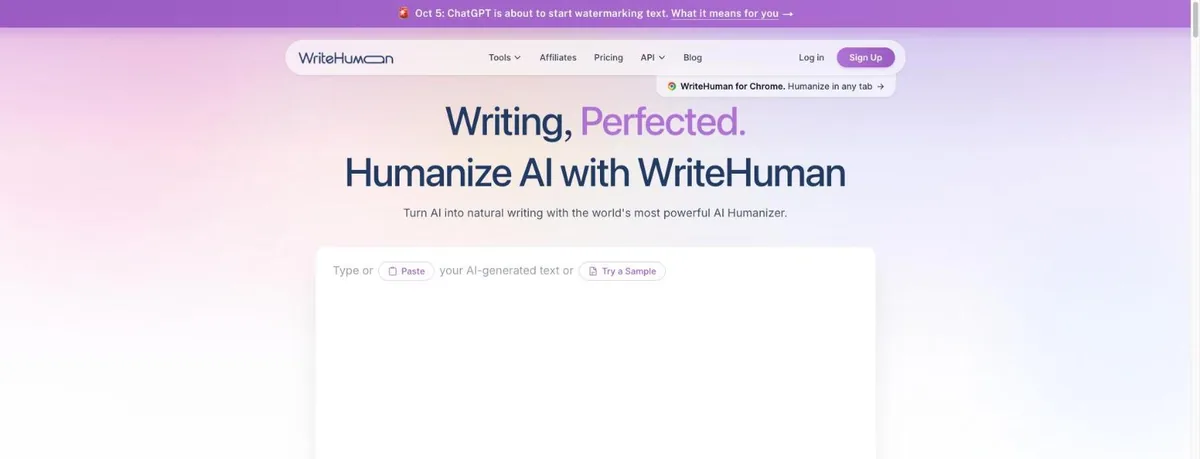
You paste text, choose Standard or the paid Enhanced model, pick a tone, and get back several versions rather than one. Basic returns two, Pro three, Ultra five. That is the feature we like most, because choosing between versions is quicker than re-rolling and it does not burn extra allowance. A text detector sits alongside the humanizer, and WriteHuman also runs a free AI image detector that needs no sign-up and, per the vendor, does not store uploads. No other humanizer in our comparison offers image detection, though WriteHuman discloses no accuracy figure for it.
The limit that shapes everything is the word cap per request: 250 words free, 600 on Basic, 1,200 on Pro, 3,000 on Ultra. A 2,000-word blog post on Basic is four separate requests, each rewritten without knowledge of the others. For a product description that does not matter. For an argued article it matters a great deal.
How we put this review together
We did not run our own humanizer benchmark, for the same reason we never do: a few samples tell you about those samples, and the result changes when the detectors update. We read the live pricing page, the terms of service updated September 21, 2026, and the image detector page on October 7, 2026, then collected every detector test with published numbers and noted who ran it and what they sell. We read the Trustpilot profile by theme. Nearly every high-ranking WriteHuman review we opened still quoted the old prices, which is why our table below does not match most of what you will find in search.
Detector results depend on length, and on the tester
| Detector | Result on WriteHuman output | Who ran it | Date |
|---|---|---|---|
| Pangram | 6 of 69 passed; average 13.3% human | Phrasly (competitor) | Sep 2026 |
| GPTZero | 84% AI paraphrasing | GPTZero (detector vendor) | Jul 2026 |
| ZeroGPT | 0% AI | GPTZero (detector vendor) | Jul 2026 |
| Copyleaks | Human-written | GPTZero (detector vendor) | Jul 2026 |
| Originality.ai | 63% original | GPTZero (detector vendor) | Jul 2026 |
| GPTZero | 82% pass rate | WebSEO Trends, 53 runs | 2026 |
| Copyleaks | 51% pass rate | WebSEO Trends, 53 runs | 2026 |
| Originality.ai | 19% pass rate; 0% on posts over 600 words | WebSEO Trends, 53 runs | 2026 |
| Originality.ai 3.0 | 81 of 100 cleared | TriedByHumans, 100 samples | May 2026 |
| GPTZero | 87 of 100 cleared | TriedByHumans, 100 samples | May 2026 |
Two things stand out. First, the testers do not agree with each other: one found WriteHuman passing Originality.ai 19 percent of the time, another 81 percent, a few months apart. Some of that is model updates and some is what was fed in. Second, length is the variable that keeps showing up. In the WebSEO Trends runs, marketing copy under 300 words passed Originality.ai 60 percent of the time and blog posts over 600 words never did. TriedByHumans found 600-word essays clearing at 92 percent and the same essays split into two 300-word chunks dropping to 79. That tells you where the tool is strong, and it is the opposite of where its request caps push you.
We nearly left the Pangram numbers out because Phrasly ran the test and Phrasly sells the competing product. We kept them, labelled, because Trustpilot reviewers in September 2026 reported Pangram catching WriteHuman output without any prompting from Phrasly, and because the test also counted something nobody else measured: WriteHuman refused to process 3 of 72 texts, including a chapter of a fantasy novel.
WriteHuman's own homepage shows human scores of 96 to 98 percent on Copyleaks, Turnitin, ZeroGPT, GPTZero and Grammarly, and calls itself the number one humanizer on something it names HumanizerBench. Both are vendor claims, and neither comes with a published method we could check. Turnitin, for its part, added detection aimed at humanizer output in August 2025, and the only Turnitin figure in the independent tests above came through a third-party proxy, not Turnitin itself.
Output quality in practice
On short marketing text the reviews are broadly kind. WebSEO Trends scored marketing copy 8.5 out of 10 and long blog posts 6, with academic and technical writing at 4.5 and 4. TriedByHumans reported about a quarter of the meaning lost on technical content. Phrasly's competitor test claimed WriteHuman made 2.64 unsupported factual changes per output and kept a quarter of the original four-word phrases, which suggests a lighter rewrite that changes facts more than it changes structure. That combination is the worst of both: easier to detect, and riskier to publish unread. Several testers also mention tone shifting inside a single document past about 800 words, which follows naturally from the chunking.
Where it works well is exactly where the hub section placed it: a 120-word product blurb, a LinkedIn opener, a 200-word abstract. Five variations on Ultra means you can often pick one and publish with light edits.
Plans, caps and a realistic monthly bill
As of October 7, 2026 the pricing page showed four tiers. Prices have risen since most third-party reviews were written; several still list Basic at $18 and Ultra at $48.
| Plan | Monthly | Annual (per month) | Requests | Words per request | Variations | MCP |
|---|---|---|---|---|---|---|
| Free | $0 | $0 | 3/mo | 250 | 1 | No |
| Basic | $20 | $12 | 80/mo | 600 | 2 | No |
| Pro | $29 | $19 | 200/mo | 1,200 | 3 | Yes |
| Ultra | $59 | $39 | Unlimited | 3,000 | 5 | Yes, 1,000/mo |
Consider a social media manager who rewrites about 120 captions and post intros a month, each 100 to 150 words. Batched four or five to a request, that is 25 to 30 Basic requests, comfortably inside 80, for $144 a year on annual billing or $240 paying monthly. Good value for the job. Now take a blogger publishing eight 1,500-word articles a month. On Basic each article is three requests, 24 in total, still inside the allowance, but every article is stitched from three separately rewritten chunks and the testers above suggest the long ones fail Originality.ai anyway. Moving to Pro halves the chunking for $228 a year. On Phrasly the same blogger would pay $131.88 a year for unlimited runs of 5,000 words, which is why we send long-form writers there or to Walter Writes instead.
The free plan
Three humanizer requests a month at 250 words each, plus ten detector checks, on the Standard model only. The Enhanced model that paid users buy the product for is not part of it, so the free plan shows you the interface and a weaker rewrite. If you want to judge WriteHuman properly you have to pay for at least a month at $20, which is the honest way to test it: buy one month, run your real copy through it, check the results on a detector you trust, then decide whether the annual price is worth committing to.
Your text, their training data
This is the section that moved our score more than any detector result. Section 8 of the terms of service, updated September 21, 2026, says WriteHuman uses everything you submit to its humanizer and detector, including the versions it generates and does not show you, to train and improve its models. The licence you grant is worldwide, perpetual, irrevocable and transferable, and can be sublicensed through multiple tiers of contractors and affiliates. The terms say plainly that it survives deleting your history, cancelling your plan and deleting your account, and that there is no setting to exclude your content.
Do not paste client copy, unpublished manuscripts, internal documents or anything under an NDA into WriteHuman's web app, extension or mobile apps. The terms exclude developer API submissions from training, so a business that must use WriteHuman should do so through the API.
The same terms are blunt on money. All payments are non-refundable except where law requires otherwise, with no refunds for partial periods or unused features. Subscriptions renew automatically and are cancelled in account settings, or through Apple or Google if you subscribed in an app. Disputes go to binding arbitration under Virginia law. The terms also forbid using the service for academic dishonesty or to break any AI-use rule that applies to you, which is worth knowing before you submit anything with your name on it.
What users say about it
Trustpilot shows 4.0 out of 5 from 307 reviews: 70 percent five-star, 22 percent one-star, very little in between. WriteHuman actively invites reviews, so the five-star share is partly solicited, and it replies to 16 percent of negative ones. The one-star themes are refunds refused on unused subscriptions, cancellations people believed they had made, unclear renewal terms, and, after a recent update, output failing Pangram.
"Extremely disappointing, no refund even when the service was never used."
Trustpilot reviewer, September 14, 2026
Reading the positive reviews, the praise is about speed, the clean interface and having several versions to pick from. Very few of them are from people humanizing anything long.
WriteHuman compared with three rivals
| WriteHuman | Phrasly | Walter Writes | Undetectable AI | |
|---|---|---|---|---|
| Cheapest paid | $20/mo; $12 annual | $10.99/mo annual | $8/mo | $9.99/mo; $5 annual |
| Allowance | 80 requests, 600 words each | Unlimited, 5,000 per run | 30,000 words/mo | 10,000 words/mo |
| Variations per run | 2 to 5 | 1 | 1 | 1 |
| Free test | 3 requests/mo | $2 trial | Limited | 250 words |
| Assistant access | MCP on Pro and Ultra | Business API | MCP server | API |
For long-form, Phrasly and Walter Writes both give you far more words for less money. For anyone who wants a detector panel on the same screen, Undetectable AI remains the better buy. WriteHuman's real edge is the variations, and that edge only matters on short text.
Buy it, or skip it
Worth paying for
- Two to five variations per run, so you pick instead of re-rolling
- Strongest results on copy under 300 words
- Free AI image detector, unique in this group
- MCP access on Pro and Ultra, plus a developer API
- Traceable founder and company history
Not worth the trade
- Perpetual training licence on your input, no opt-out
- 600-word cap on Basic forces chunking
- Long posts failed Originality.ai in independent runs
- No refunds, including on unused plans
- Free plan excludes the Enhanced model
- Prices rose in 2026; most reviews online are out of date
Buy it if your work arrives in short, non-confidential pieces and you value choosing between versions: social posts, ad variants, meta descriptions, short abstracts you wrote yourself with AI help. Pay annual if you are sure, monthly for one month if you are not. Skip it if you write anything over 800 words, if you work with client or unpublished material, if you want the option of a refund, or if you are a student. The terms forbid academic misuse and the detectors most universities use are the ones it does worst against.
Quick questions about WriteHuman
Does WriteHuman work?
On short text against weaker detectors, often. GPTZero still flagged it in July 2026, and a Pangram test passed 6 of 69 outputs.
What does it cost?
Basic is $20 a month or $12 on annual for 80 requests of up to 600 words. Pro is $29 or $19, Ultra $59 or $39, as of October 7, 2026.
Is the free plan worth using?
Three requests of 250 words a month. Enough to see the interface, not enough to judge the output.
What happens to the text I paste in?
The terms let WriteHuman train on it permanently, even after you delete your account, with no opt-out. API submissions are excluded.
Can I get a refund?
Payments are non-refundable except where the law requires. Cancel in account settings before the renewal date.
Is it good for long articles?
No. Even Pro caps a request at 1,200 words, and testers report meaning drift past about 800.
Who makes it?
WriteHuman LLC of Midlothian, Virginia, launched in 2023 by Ivan Jackson. It started as a one-person company.
Verdict
WriteHuman does one thing well. Give it a short piece of copy and it hands back several decent versions, and on text that short the detector results are respectable. Everything about its pricing structure, its test results and its chunking pushes against longer work, and its September 2026 terms ask for a permanent, irrevocable right to train on whatever you paste in. For a social team humanizing public-facing captions that trade is acceptable at $12 a month. For anyone handling words that belong to someone else, it is not, and we would choose a different tool.