 By
By The cheapest words in the category, from a company you should not trust with a renewal date. Walter Writes sells 30,000 words for $8 a month and 200,000 for $26 on annual billing, includes a detector and an MCP server on every plan, and writes cleaner sentences than most rivals. Detector results are middling, the free sample is tiny, and its Trustpilot page is 70 percent one-star, mostly about refunds.
- Best for
- Content teams and newsletter writers humanizing their own drafts at volume
- Skip if
- You cannot commit a year, you want a real free test, or you need an essay to survive Turnitin
- Price
- $8/mo billed yearly ($96 upfront) for 30,000 words
- Trustpilot
- 2.0 from 50 reviews
Who is behind Walter Writes
Walter Writes is a humanizer first and, these days, a detector second. You paste AI-assisted text, pick a rewrite strength, and it returns a version meant to read less like a language model and score lower on AI checkers. Around that core the company has bolted on a surprising amount: a Chrome extension, iOS and Android apps, a ChatGPT watermark remover, MCP connectors for Claude and Codex, and a separate API platform selling image, voice, grammar and plagiarism detection. The homepage now calls Walter "the AI authenticity platform", which is a long way from a rewriting box.
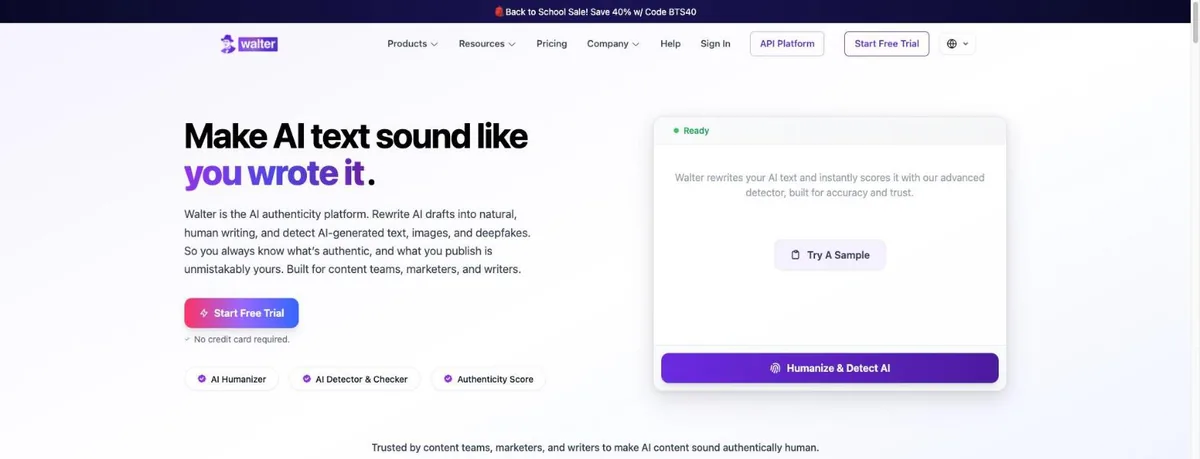
The company is Walter AI Inc. Its terms of service give an address on rue Saint-Nicolas in Old Montréal and say the agreement is governed by the laws of Delaware, a common setup for a Canadian startup with a US entity. The iOS app is published under an individual developer name, Hamza El Jaadi, rather than the company. We found no funding announcement, no leadership page and no press coverage of the business itself.
None of that is a mark against the product. It is a reason to prefer short commitments, which the pricing page works hard to talk you out of.
Where our evidence comes from
Humanizer reviews are a swamp, and the Walter Writes corner of it is boggier than most. Search the name and the first page is crowded with Substack posts, several of them glowing, one openly titled as coming "from the team that built it". Others quote a plan structure that no longer exists, with a $10 Starter for 10,000 words and an "Unlimited" tier, written once and never checked again. We threw out anything we could not tie to a named tester, a date or a primary source.
What survived: the vendor's pricing page and terms of service, both read on October 7, 2026; the HumanizerBench leaderboard, updated October 1, 2026; iTechGuides' product page, fact-checked September 21, 2026; the Trustpilot profile; the App Store listing for the iOS app; and one small hands-on test on Substack whose author does not appear to be connected to the vendor.
We wanted to give you a tidy pass-rate table with Turnitin in the first row. We gave up. The only multi-tool benchmark that publishes its data is run by a rival, and the small independent tests report pass or fail with no percentages. If someone shows you a precise Walter Writes Turnitin score, ask who ran it. Most cannot say.
Does the output get past detectors?
The homepage promises "detection-proof" content. That is the vendor's claim, and the evidence supports something more modest.
HumanizerBench runs each tool on 30 prompts across several writing categories and scores the results against six detectors: GPTZero, ZeroGPT, Copyleaks, Winston AI, Originality.ai and Pangram. Bypass rate carries 42 percent of the weight, meaning preservation 32, readability 16 and consistency 10. In the October 1, 2026 update Walter Writes posted a bypass score of 72.8, a touch ahead of StealthWriter at 71.3 and a touch behind Undetectable AI at 74.6. It finished 10th of 14 overall on 63.53.
The placement is worse than the bypass number because of two deductions: meaning drift, where the rewrite says something slightly different from the original, and length inflation, where it comes back longer than it went in. Both are editing problems rather than detection problems, and both land on you.
One caveat that matters. HumanizerBench is operated by WriteHuman, which sells a competing humanizer and placed itself first. The organisers publish every input, output and detector response, which is more than any vendor-run test we have seen, but you should read the ranking knowing who built it.
Smaller tests point both ways. A Substack writer who ran one 500-word ChatGPT draft through six humanizers reported that Walter's version cleared GPTZero, Originality.ai and Turnitin on the first pass, without publishing scores. Against that, a Trustpilot reviewer says Walter's own checker called a text 100 percent human while Turnitin scored it 73 percent AI. Neither is a measurement.
The practical upshot: the built-in detector is a convenience, not a referee. For anything that matters, run the text through the checker your client, editor or school actually uses. Our GPTZero review explains why even that result needs a pinch of salt.
What the rewrites read like
Walter's best quality is that its sentences are mostly sentences. On the HumanizerBench readability measure it scored 63.5, level with Undetectable AI's 63.9 and far above StealthWriter's 41.8, which was the lowest of all 14 tools. In practice that means fewer of the thesaurus swaps that make humanized text read like a translation of a translation. Fewer, not none: one Trustpilot reviewer complains it "replaces words with other, similar words that make the content sound much less human than it did originally".
App Store reviewers raise a different problem, which is register. Several say the academic and professional settings still produce a chatty voice, and one describes doctorate-level output that "reads like a high school-level millennial". If you write to a formal house style, expect to pull the tone back up by hand.
The per-request cap shapes the workflow more than any setting. Starter accepts 750 words at a time, Pro 1,500, and Elite and Teams 2,000. A 2,400-word article on Starter becomes four separate requests, each rewritten without knowledge of the others, so the joins between chunks need a human pass. The vendor says standard documents take 10 to 30 seconds to process. Speed is not the bottleneck. Stitching is.
Plans, word caps and what you will actually pay
As of October 7, 2026 the pricing page leads with yearly billing, and the per-month figures everyone quotes are annual prices divided by twelve and charged in one go. Month-to-month billing exists and costs more. The toggle promises yearly savings of "up to 43%", but the page did not show us plan-by-plan monthly prices we could verify, so the table sticks to what we could confirm.
| Plan | Per month, billed yearly | Charged upfront | Words per month | Words per request |
|---|---|---|---|---|
| Free trial | $0 | $0 | 300, once | 300 |
| Starter | $8 | $96 | 30,000 | 750 |
| Pro | $13 | $156 | 70,000 | 1,500 |
| Elite | $26 | $312 | 200,000 | 2,000 |
| Teams (10 seats) | $99 | $1,188 | 500,000 | 2,000 |
Every paid plan gets the same features: the humanizer, the built-in detector, MCP access, 80-plus languages and watermark removal. You are buying volume and request size, nothing else, which makes choosing refreshingly simple.
Here is a realistic case. A two-person content shop rewrites its own AI-assisted drafts: eight 1,800-word blog posts a month and 120 product descriptions of about 250 words. That is 14,400 words of posts and 30,000 of descriptions, 44,400 in all, before re-runs. Redo a quarter of the outputs because a paragraph came back wrong and you are near 55,000 words. Starter is out. Pro fits with headroom, and its 1,500-word cap turns each blog post into two requests instead of three. The bill is $156 today, $13 a month in effect, or roughly 24 cents per thousand words. Undetectable AI's largest standard plan stops at 50,000 words for $42.50 a month, so the same job would not fit there at all.
The catch is that the $156 is gone the moment you pay. The refund window closes after three days or 1,500 words, whichever comes first, and renewals are final. If you are unsure you will still need 70,000 words in month nine, pay monthly for one cycle and accept the premium.
Buying inside the iOS app is a different deal. As of October 7, 2026 the App Store lists its own subscriptions for "W. Writes AI Humanizer": $7.99 a week after a $3.99 first week, $14.99 a month after a $5.99 first month, or $89.99 a year. The listing does not say how many words those buy. If you want the plans in the table above, subscribe on the website.
The free trial is a sample, not a test
The free tier is 300 words, once, with no login and no card. The pitch is accurate as far as it goes: it is the same engine paid users get, with no watermark on the output. But 300 words is a paragraph and a half. You cannot see how it handles a 1,500-word article, whether the chunk boundaries show, or whether its detector agrees with yours over several runs.
Even other reviewers are unsure what is on offer. iTechGuides lists the free plan as "No" and describes a three-day trial instead. If what you need to know is whether humanizing works on your writing at all, StealthWriter's ten free runs a day at up to 1,000 words is the better laboratory. Come back to Walter when the question becomes price.
What paying customers complain about
Trustpilot is not kind. As of October 7, 2026 Walter Writes holds 2.0 out of 5 from 50 reviews, 70 percent of them one-star and 14 percent five-star. The themes, roughly in order: refunds refused, charges people say they did not expect, output that still got flagged, and support that feels automated. One reviewer put it in a single line:
"They charged me without notifying and when asked for refund they refused."
Trustpilot reviewer, walterwrites.ai profile
Two things soften that. Fifty reviews is a small sample, and unhappy buyers write reviews far more readily than satisfied ones. The company also answers: Trustpilot shows replies to 89 percent of negative reviews, usually within a day, which is better than StealthWriter or GPTZero manage.
Answering is not refunding, though, and the terms explain why so many requests fail. The refund promise covers only your first-ever subscription payment, only for three days, and only if you have processed 1,500 words or fewer. Run one long article through Pro on the first evening and you may already be over the line. Renewals are described as "final and non-refundable". Cancelling, at least, is self-service: the terms say you can do it from your account, effective at the end of the paid term. Set a calendar reminder a week before renewal, because nothing in the terms suggests you will get one.
The App Store paints a gentler picture at 4.0 from 145 ratings, but the written reviews repeat the tone complaint and add that the in-app detector missed text a teacher's software caught.
Privacy, terms and the student question
Walter's terms say it "firmly oppose[s]" use of the tool for academic dishonesty and does not support getting around educational AI detection where that detection exists to prevent misconduct. Its homepage, meanwhile, sells "detection-proof" writing. Both statements can live in the same company legally. You can decide what the combination tells you. For students, our answer is the same for every humanizer: if your course forbids submitting AI-generated work, rewriting it does not change what it is, and these terms put the risk squarely on you.
On privacy, the web app processes your text on Walter's servers, like every tool in this category. The iOS app goes further. Its App Store privacy label discloses identifiers used to track you across other companies' apps and websites, plus device and user IDs for analytics. That is ordinary for a consumer subscription app and an odd look for a product sold on authenticity. If you are pasting client copy, use the web version.
The MCP connector deserves a line here too. Hooking Walter into Claude or Codex lets your assistant send text without a copy-paste step, which is a real time saver for content teams. It also means drafts leave your assistant's environment for a third party's servers, so decide which documents you are comfortable routing that way.
Walter Writes against Undetectable AI, StealthWriter and Phrasly
| Walter Writes | Undetectable AI | StealthWriter | Phrasly | |
|---|---|---|---|---|
| Cheapest paid | $8/mo billed yearly | $9.99/mo; $5 annual | $20/mo | $10.99/mo annual |
| Volume | 30,000 words/mo | 10,000 words/mo | 50 runs/day, 5,000 words each | Unlimited, 5,000 per run |
| Free tier | 300 words, once | 250 words, once | 10 runs/day, 1,000 words | $2 three-day trial |
| Built-in detector | Yes | Yes, multi | Yes | Plagiarism only |
| HumanizerBench overall, Oct 2026 | 63.53 (10th) | 71.18 (3rd) | 65.98 (8th) | 61.79 (12th) |
Undetectable AI is the safer choice at low volume: a better benchmark placement, a panel of detectors on the output screen, and a $5 annual Starter, though it strips formatting and tops out at 50,000 words. Our Undetectable AI review covers its billing complaints, which rhyme with Walter's. StealthWriter is where to experiment before paying anyone. Phrasly posted the highest raw bypass score on HumanizerBench at 95.3 and the weakest meaning preservation of these four, which is the trade you would expect from a tool that changes text that aggressively.
Walter's case is volume. Somewhere past 30,000 words a month nothing else here comes close on price, and the full humanizer comparison shows the gap widening at every tier above that.
Who it suits, and who should stay away
Why it made our shortlist
- Most words per dollar in the category on yearly billing
- Same features on every plan, detector included
- MCP connectors for Claude and Codex
- Readability level with Undetectable AI on HumanizerBench
- Self-service cancellation from the account page
- Replies to most negative reviews within a day
Why it is not higher
- Headline prices need a year paid upfront
- 300-word free sample, once
- Refunds only within 3 days and under 1,500 words
- 10th of 14 on HumanizerBench overall
- 750-word request cap on Starter
- iOS app priced separately and tracks users
Buy it if you run a content team, an agency or a newsletter that processes 30,000 words or more a month of your own AI-assisted drafts, you were going to edit the output anyway, and you have already tested humanizing on someone else's free tier. Pro is the sweet spot for most small teams; Elite makes sense once you are past about 70,000 words.
Skip it if you write a few thousand words a month, because Undetectable AI's $60-a-year Starter is cheaper in absolute terms. Skip it if you cannot commit for twelve months, if your output has to survive Turnitin, or if you are a student hoping software will make an assignment acceptable. It will not, and Walter's own terms agree.
Short answers about Walter Writes
Is Walter Writes free?
Barely. 300 words, once, no card needed. Enough to see the style, not enough to judge it.
What does it really cost?
$8, $13, $26 or $99 a month, but those are yearly prices charged upfront: $96 to $1,188. Paying month to month costs more.
Does it get past detectors?
Sometimes. It placed 10th of 14 on HumanizerBench in October 2026, with a bypass rate a little behind Undetectable AI.
Does it have a detector now?
Yes, every plan lists a built-in AI detector. Treat its score as a hint and confirm anything important elsewhere.
Can I get a refund?
Only on your first payment, within 3 days, with 1,500 words or fewer used. Renewals are non-refundable.
Who runs it?
Walter AI Inc., with a Montréal address and Delaware law in its terms. The iOS app is published under Hamza El Jaadi's name.
Should students use it?
Its own terms oppose academic dishonesty. If your course bans AI-written work, rewriting it does not change that.
Verdict
Walter Writes is the value pick in our humanizer ranking and we stand by that. The per-word price on yearly billing is in a different league, the rewrites read better than its benchmark placement suggests, and the MCP connector saves a content team real minutes every day. What holds it at 3.3 is everything around the product: prices that assume a year upfront, a refund window narrow enough to miss without noticing, a Trustpilot page full of people who missed it, and detector results in the middle of the pack rather than the "detection-proof" the homepage promises.
Test somewhere free, work out your monthly volume honestly, then buy Pro or Elite knowing the money is committed. If your volume is small, the cheapest plan on this page is not the cheapest plan for you.