 By
By A genuinely useful feature set wrapped around an accuracy claim you should ignore. OCR for scans and handwriting, image and deepfake detection, plagiarism and a clean sentence map make Winston the most versatile detector here, and the annual plans are cheap per word. The 99.87 percent badge is self-measured, competitor tests found real misses, and the monthly prices are steep for what light users need.
- Best for
- Teachers with paper or scanned submissions, and anyone who needs text and image checks in one place
- Skip if
- You want independently audited accuracy, you only need occasional checks, or you will not commit to annual billing
- Price
- $18/mo or $120/yr list (100,000 credits a month)
- Trustpilot
- 3.8 from 28 reviews
What Winston AI is, and the company behind it
Winston AI Inc. is a small Montreal company, founded in 2022 and run from an office on Mont-Royal Ouest, with Thierry Lavergne among its co-founders. Unlike Copyleaks or GPTZero, it has no public funding round we could find and publishes very little about its team, so what we know about the business mostly comes from the product and the legal pages. It says it is trusted by more than 10 million users, which is a company claim and the kind of figure that usually counts free sign-ups.
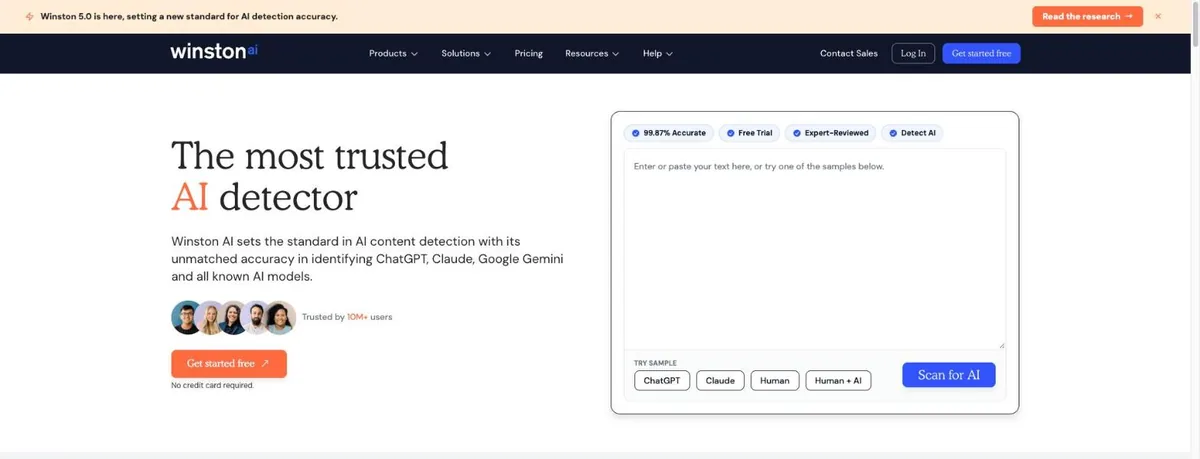
The core product is an AI text detector that returns a "human score" and a colour-coded prediction map showing which sentences drove it. Around that sits a long list of extras: plagiarism checking, AI image and deepfake detection, OCR for scanned documents and handwriting, writing feedback, an essay grader, a fact checker, a Chrome extension, and integrations with Google Classroom, WordPress and Zapier, plus an API. Detection is offered in 14 languages, from English and French to Tagalog and Simplified Chinese. The site says it is GDPR compliant and SOC 2 certified, and that Winston is a member of the Content Authenticity Initiative. A "Winston 5.0" banner was running across the homepage when we visited, promising a new standard in accuracy.
How we checked the 99.87 percent
Winston has quoted more than one headline number over the years. Reviews from 2024 and 2025, including GPTZero's and Unite.ai's, cite "99.98% accuracy"; the homepage now says 99.87 percent "on a 10,000-sample dataset". The change is small. What has not changed is that the dataset is Winston's and the measurement is Winston's.
So we looked for anyone else's. We found one academic study that includes Winston, from the University of Florida, two hands-on tests by competing detector companies (GPTZero and Originality.ai), and a handful of review-site compilations whose figures we could not trace back to a source and have therefore left out. We also read the pricing page and the help centre on October 7, 2026, the privacy policy, the Trustpilot and Capterra pages, and the trial terms.
We nearly scored "Independent evidence" lower than we did. The Florida study is a genuinely good result for Winston, and it would be unfair to bury it because there is only one of it.
Accuracy: one good study, two hostile tests
| Test | What was tested | Winston result | Who ran it | Year |
|---|---|---|---|---|
| Vendor benchmark | 10,000 samples, not published | 99.87% accuracy (claimed) | Winston AI | 2026 |
| ChatGPT vs human conference abstracts | EDM 2022 and LAK 22 abstracts, five detectors | AUC 0.991 to 1.000; GPTZero 0.601 to 0.605 | Li, Lee and Botelho, University of Florida | 2024 |
| Same study, human abstracts | Average AI score on real abstracts | 0.069 to 0.125 | University of Florida | 2024 |
| AI paragraphs inside a 22,000-word human document | One long mixed document | Called it 100% human | GPTZero (competitor) | Not dated |
| Three GPT-5 samples | Blog post, email, e-book extract | 100%, 87% and 3% AI | Originality.ai (competitor) | Oct 2025 |
The University of Florida paper, presented at Educational Data Mining 2024, is the result Winston should be quoting instead of its own badge. Hongming Li, Seiyon Lee and Anthony Botelho took real abstracts from two 2022 education conferences and ChatGPT-written versions of them, and Winston separated the two almost perfectly, with an AUC (a measure of how cleanly a classifier ranks AI above human, where 1.0 is perfect) between 0.991 and 1.000. GPTZero, on the same texts, managed about 0.6. Winston also gave genuine human abstracts low average AI scores, which is encouraging on false positives, although the paper does not report a false-positive rate as such.
The same study carries a warning. All five detectors, Winston included, tended to classify mixed human-and-AI writing as mostly human. That lines up with GPTZero's own test, in which AI paragraphs dropped into a 22,000-word human document produced a "100% human" verdict from Winston, and with Originality.ai's October 2025 run, in which a GPT-5 e-book extract scored just 3 percent AI. Both of those come from competitors with every reason to find a miss, so weigh them accordingly. They still describe a recognisable pattern: Winston is strong on a clean block of chatbot text, and much less sure once the AI is diluted, edited or written by a newer model.
What we do not have is any independent false-positive rate, the figure we care about most. Copyleaks has Bloomberg's 500-essay test. Winston has nothing comparable. Until it does, treat a high Winston score on a student's essay as a reason to ask questions, not as an answer.
The OCR feature, and what it cannot do
This is the reason Winston is on our shortlist at all. Upload a scanned PDF, a phone photo of an exam script or a picture of a handwritten page, and Winston converts it to text and runs the detector on the result. Nobody else in our detector comparison does this. For teachers who still collect paper, for exam boards, and for anyone auditing old printed archives, it removes a retyping step that otherwise makes detection impractical.
Two cautions. Unite.ai's review lists handwriting detection as unreliable, and the only Capterra reviewer (one review, rated 4.0) praised the OCR but called the PDF reports shallow and noted that you cannot scan content by URL. And there is a logical problem worth thinking through: any OCR error changes the text the detector scores. A misread word or a broken sentence is exactly the kind of irregularity that can push a score in either direction. We would trust Winston's OCR output for typed scans and treat its verdict on handwriting as a rough guide, then check the transcription before reading anything into the score.
Pricing and the credit maths
Winston sells credits. According to GPTZero's review of the product, one credit covers one word of AI detection and a plagiarism scan costs two credits per word, so a document checked for both uses three credits a word. The pricing page itself does not spell this out, which is our main complaint about it. Here are list prices as of October 7, 2026, taken from Winston's help centre.
| Plan | Monthly | Annual (per month) | Annual total | Credits per month | Team |
|---|---|---|---|---|---|
| Free trial | $0 | 2,000 for 14 days | 1 | ||
| Essential | $18 | $10 | $120 | 100,000 | Team invites |
| Advanced | $29 | $16 | $192 | 200,000 | Up to 5 |
| Elite | $49 | $26 | $312 | 500,000 | Unlimited |
| Enterprise | Custom quote | ||||
On October 7, 2026 the pricing page was showing a 50 percent discount with the code BTS50, which brought Essential to $9 a month or $60 a year. Promotions on this page come and go, so budget on the list prices above and treat any code as a bonus.
The gap between monthly and annual is the biggest in the category. Essential costs $216 a year if you pay monthly and $120 if you pay up front, a 44 percent saving. That matters, because the people most likely to want Winston, teachers, tend to need it for a school year rather than for one month.
Two worked examples. A freelance editor checking 20,000 words of client copy a month for AI only would use a fifth of the Essential allowance; on monthly billing that is $18 for work GPTZero's free tier nearly covers, so Winston only makes sense for this person on annual, at $10 a month. A teacher with five classes of 25, each handing in one 1,000-word essay a month, generates 125,000 words. AI detection alone needs 125,000 credits, which is over the Essential cap and means Advanced at $29 a month or $16 on annual. Add plagiarism checking and the same essays draw 375,000 credits, which is Elite territory: $49 a month, or $312 for the year. Compared with Copyleaks, where 25,000 words costs $16.99, Winston's annual plans buy a lot more scanning per dollar.
Cancellation, per the pricing page, takes effect at the end of the current paid term. We found no money-back guarantee on the page, so an annual plan is a commitment.
The 14-day trial
There is no permanent free plan. New accounts get 2,000 credits for 14 days, with no card required, and the trial includes the full feature list: OCR, image detection, plagiarism and PDF reports. At one credit per word, 2,000 credits is two essays of AI detection, or fewer if you also run plagiarism. That is enough to see whether the prediction map and the OCR suit you, and nowhere near enough to test accuracy on your own material. GPTZero's 10,000 free words a month remains the better way to test detection itself, as our GPTZero review explains. Use the Winston trial for the thing only Winston does: upload a couple of real scans and see how well it reads them.
Privacy, and the business of certifying humans
The privacy policy is clearer than most in this category. Submitted text and images are stored so that reports can appear in your dashboard; delete a report and the content goes from active storage within 30 days, and deleting your account clears everything on the same timeline. Winston says it does not use identifiable submitted content to train AI models without explicit consent, and that files sit in encrypted, access-controlled cloud storage. It does not say where that storage is, which a European school may want to ask about. We found no breach, regulator action or lawsuit involving the company.
The part we find odd is HUMN-1. On the Advanced plan and above, Winston offers a website certification, a badge publishers can display to signal that their content is human-written. A detector company selling a "certified human" badge is grading content it is also paid to vouch for, and its detector has, on the evidence above, missed AI text that had been mixed with human writing. We would not put much weight on that badge as a reader, and we would think hard before paying for it as a publisher.
What users say
There is not much to go on, which is itself informative for a product claiming ten million users. Trustpilot shows 3.8 out of 5 from just 28 reviews: 71 percent five-star, 25 percent one-star, almost nothing between. The positive reviews like the sentence-level explanation rather than a bare percentage, and several name a support agent, Elodie, for fast, helpful replies. The negatives are the familiar detector complaints, sharpened. One reviewer found that well-written text got flagged as AI while sloppy, error-strewn text passed as human. Another called claims of unlimited features "fake", and a third reported support emails going unanswered. Trustpilot notes that Winston has not replied to its negative reviews.
"Shows what might be flagged and lets you revise."A Winston AI reviewer on Trustpilot
Capterra has a single review. If you are making an institutional purchase, ask Winston for references from schools of your size, because the public review record will not tell you much.
Winston AI against Copyleaks, GPTZero and Originality.ai
| Winston AI | Copyleaks | GPTZero | Originality.ai | |
|---|---|---|---|---|
| Paid from (monthly) | $18 | $16.99 | $14.99 | $14.95 |
| Best annual price | $120/yr, 100K credits/mo | $167.88/yr, 25K words/mo | $8.33/mo, 150K words | Credit-based |
| Free access | 14-day trial, 2,000 credits | Scan box, small allowance | 10,000 words/mo | 60 credits/mo |
| Independent accuracy | One study, strong on clean text | Peer-reviewed, strong; 66% on mixed | 52 to 95% | 76 to 92% |
| Independent false positives | Not published | 1 to 2% | 1 to 12% | 4.8 to 5.7% |
| OCR for scans and handwriting | Yes | No | No | No |
| Image detection | Yes, plus deepfakes | Yes | No | No |
Copyleaks is the safer tool to point at a person, because its false-positive record is measured; our Copyleaks review covers it in detail. GPTZero is the better free option and the better classroom ecosystem. Originality.ai is the one for publishers worried about humanized copy. Winston wins on breadth and on paper, and on price per word if you pay annually.
Who should buy it, and who should not
Where it earns its place
- The only OCR for scans and handwriting in the category
- Image and deepfake detection in the same account
- Strong independent result on clean ChatGPT text
- Cheap per word on annual plans
- Clear deletion and no-training privacy terms
- Responsive support, by most accounts
Where it falls short
- Headline accuracy is self-measured
- Missed AI mixed into human text in two tests
- No independent false-positive rate
- Monthly prices are 80 percent above annual
- Trial is too small to test accuracy properly
- Selling a human-content badge sits awkwardly with detection
Buy Winston if you teach and still collect paper, if you need to check images as well as text, or if you run enough words through a detector each month that its annual credit allowance beats a per-word plan. Look elsewhere if you need a number you can defend in a misconduct hearing (Copyleaks has better evidence), if you want to scan a few essays a month for free (GPTZero), if your worry is freelancers running AI copy through a humanizer (Originality.ai), or if you are not willing to commit to a year, because the monthly plans are poor value.
Questions readers ask about Winston AI
Is Winston AI accurate?
On clean ChatGPT text, a 2024 University of Florida study found it separated AI from human abstracts almost perfectly. Competitor tests found it missing AI passages inside longer human documents.
Is the 99.87 percent real?
It is Winston's own figure on its own 10,000-sample set. No independent test we found has reproduced it.
How much does it cost?
$18 a month, or $120 a year, for 100,000 credits at list price. A half-price promo code was live on October 7, 2026.
Is there a free plan?
A 14-day trial with 2,000 credits, roughly 2,000 words of AI detection. No card required.
Can it really read handwriting?
Yes, through OCR on photos and scans. Reviewers report handwritten results are less dependable than typed text.
How do credits work?
One credit per word for AI detection and two per word for plagiarism, according to GPTZero's review. Running both triples the draw.
Who is behind it?
Winston AI Inc., a Montreal company founded in 2022. We found no public funding round.
Verdict
Winston AI is better than its marketing. The one serious independent study of it is flattering, the OCR solves a problem nobody else touches, and on annual billing the price per word is among the lowest of any credible detector. It is also a small company leaning on a self-measured accuracy badge, with no independent false-positive data, a known weakness on mixed documents, and a side business certifying content as human. Buy it for the paper and the images, on an annual plan, with a human reading every flagged piece.
If none of your work arrives on paper, start with GPTZero's free tier or Copyleaks instead.