 By
By Risk note. Day trading stocks can lose money fast, and automated execution makes losses faster, not smaller. Holly's signals are not personal advice, past results do not predict future ones, and nothing on this page is investment advice.
The best scanner in retail trading, bolted to an AI whose report card it writes itself. Trade Ideas has spent two decades building tools for people who trade US stocks every session, and it shows. Holly is a real overnight-trained signal engine rather than a chatbot with a trading logo. The price, the no-refund policy and the selective way results are shown mean only a narrow group of traders should buy it.
- Best for
- Full-time or near full-time US day traders with five-figure accounts who already live in scanners
- Skip if
- You swing trade, trade crypto or forex, use a Mac only, or have an account under about $25,000
- Price
- $1,068/yr Standard; $2,268/yr Premium (Holly, autotrade)
- Trustpilot
- 3.8 from 46 reviews; 39 percent one-star
The company behind the scanner
Trade Ideas is old by fintech standards. The company's own profile of its founder and CEO, Dan Mirkin, published in January 2026, says it started in 2002 with about $100,000 of self-funded capital, has never taken outside money, and runs with roughly 25 staff, including a CTO Mirkin has known since high school. The logo says "since 2003", which is presumably when the product shipped. David Aferiat is the other co-founder most often named. The site also says it made the Inc. 5000 list of fast-growing private companies four years running, 2017 to 2020, and that the software is "made 100% in the USA". Those are company claims and we have not checked them against Inc.'s archive.
Bootstrapped matters. No venture fund is pushing for an exit, which partly explains why the product changes slowly and why the desktop app still looks like 2012. It also means the business lives on subscriptions from a small, demanding audience, and you can feel that in the pricing.
Holly, without the brochure
Holly launched in 2016 and now comes in several flavours, including Holly Grail, Holly 2.0 and Holly Neo. The mechanism, as the company describes it on its comparison page, is this: every night it backtests more than 60 strategies across more than 8,000 US stocks, keeps the ones whose recent statistics clear its thresholds, and delivers trade ideas with an entry, a stop and a target by the open. Day Trading Toolkit reports that it typically issues 5 to 25 ideas a day, and FinMasters notes that it does not hold positions overnight.
That is a real model doing real work, a different category from the setup chatbots most crypto platforms call AI. It also has a well-known weakness. Choosing whatever strategy happened to perform best over the recent window is a form of curve fitting, and the strategies that survive a nightly selection are, by construction, the ones that fit the last few weeks. Sometimes the market keeps behaving that way. The company itself calls Holly "a probability engine, not a prediction machine", which is the most honest sentence on the site.
The newer pieces, a Trade Ideas GPT chat box on the homepage and a beta called Money Machine, have no independent testing we could find. Treat them as features, not reasons to buy.
Does Holly make money? The evidence by source
We did not subscribe for a quarter and report our profit, because one person's three months tells you about those months. We read the vendor pages on October 7, 2026, four long independent reviews (StockBrokers.com, Day Trading Toolkit, Liberated Stock Trader and FinMasters), every Trustpilot review, Capterra, and the FINRA and SEC material that applies to US day traders. Most ranking reviews skip three things we spend time on: the fee as a share of a real account, this year's change to the $25,000 rule, and how little of Holly's record a non-subscriber can see.
Capterra lists Trade Ideas at $17 a month. That is an alerts add-on, not the platform. When a review site gets the headline price wrong by a factor of ten, we use it for user-review themes only.
| Source | What it says | Who produced it | Period |
|---|---|---|---|
| Trade Ideas homepage | SDEV +297%, CYPH +125%, QMCO +94% | Vendor, selected winners | Recent |
| Liberated Stock Trader analysis | Holly 2.0 +61% vs S&P 500 +32% | Review site, using Trade Ideas' published data | Jan 2019 to Oct 2020 |
| Liberated Stock Trader analysis | Holly Grail and Holly Neo +42% each | Same | Same |
| StockBrokers.com | Results look "cherry-picked"; no full win/loss breakdown | Independent reviewer | June 2026 |
| Day Trading Toolkit | No public overall win rate; full history only inside the platform | Independent reviewer | 2026 |
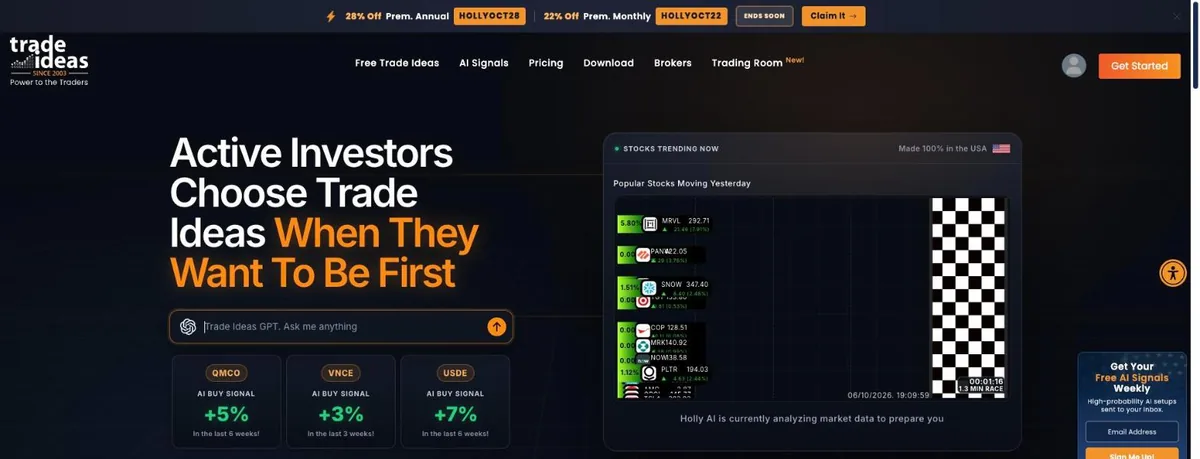
Look at where the positive numbers come from. The homepage figures are single winning trades, and on the day we captured the page the tiles showed gains of 3 to 7 percent and nothing else. The only multi-strategy return figures we found are a review site's reading of Trade Ideas' own data over a window that included the 2020 crash and the very sharp rebound that followed, which flattered almost any long-biased intraday system. Nobody has published an audited, all-trades, after-slippage record. Trade Ideas does not claim one exists.
It is worth separating win rate from return here, because the marketing never does. A strategy can win most of its trades and still lose money if the losers are larger than the winners, and an intraday system with tight targets and wider stops often has exactly that shape. A strategy can also win only 40 percent of the time and be profitable because the winners run. The single number that would tell you something is expectancy after costs, across every signal, over several years and different market regimes. That number is not public.
Past performance of any signal engine, Holly included, is not predictive. A strategy selected because it did well last month is the definition of a result that may not repeat. Paper trade the signals in the simulator before connecting a broker, and keep a log of every signal you skip as well as the ones you take.
Autotrading, brokers and where your money sits
Your cash and shares never touch Trade Ideas. They stay at your broker, which is a FINRA member with SIPC coverage, and Trade Ideas sends orders through a link the company calls Brokerage Plus. StockBrokers.com lists Interactive Brokers, TradeStation and E*TRADE for that link, and Day Trading Toolkit and Liberated Stock Trader add Alpaca. CenterPoint Securities, Cobra Trading and moomoo appear as partners, which Day Trading Toolkit describes as partner access rather than full integration. Robinhood and Webull are not connected.
Autotrade is a Premium feature and the riskiest button in the product. Turn it on in the simulator first. Set a hard daily loss limit at the broker, not just in Trade Ideas, because a broker-side limit still works when the desktop app freezes, and freezing is a common Trustpilot complaint. Start with one strategy and a small share size, and if your broker offers a separate sub-account, use it so a runaway strategy cannot touch your long-term holdings.
The desktop app is Windows software. Mac users run the web version, which StockBrokers.com found repetitive, or a Windows virtual machine, and several reviewers report it as a recurring headache.
What it costs, and what it costs you
| Plan | Annual (vendor page) | Per month on annual | Monthly billing (reported) | Holly, signals and autotrade |
|---|---|---|---|---|
| Standard | $1,068 | $89 | $127 | No. Scanner, 10 charts, simulator, trading room |
| Premium | $2,268 | $189 | $254 | Yes. Holly, entry and exit signals, backtesting, Brokerage Plus autotrade, 20 charts |
| TI Strength Alerts add-on | $17 | Alerts only |
The annual figures are from Trade Ideas' pricing page as of October 7, 2026, which shows only annual prices. The monthly figures are from StockBrokers.com in June 2026 and Day Trading Toolkit, which agree with each other. Plan names drift between sources (Standard and Premium on the vendor page, Birdie and Eagle or Core and Apex elsewhere), and one review quotes $2,136 a year for the top tier; we use the vendor's $2,268. On the day we checked, a banner offered 28 percent off annual Premium and 22 percent off monthly Premium with codes, and discount codes are a near-permanent fixture, so do not pay list price without looking for one.
Here is what that means for a realistic buyer. Say you trade a $30,000 margin account and you want Holly, so you need Premium. On annual billing that is $2,268, or 7.6 percent of the account, before commissions, slippage or taxes. Your trading has to beat the market by that margin just to match a buy-and-hold index investor who paid nothing. On a $10,000 account the same plan is a 22.7 percent hurdle, which is why we think the price makes the decision for most people. On monthly billing, three months of Premium to see if it suits you costs about $762, and you cannot get any of it back.
Trade Ideas' pricing page states that all sales are final, with store credit or exchanges instead of refunds. Day Trading Toolkit reports that purchases made with a promo code get no refund, credit or exchange at all. Treat any purchase as spent the moment you click.
Is there a free way in?
Not really, and this is the weakest part of the offer. There is no standing free trial. The free route is a live trading room, which is useful for watching how the regulars use the scanner, plus free stock information pages and an email list of selected AI signals. Day Trading Toolkit mentions occasional paid "Test Drive" events. None of these lets you put Holly on your own watchlist, in your own hours, for long enough to judge it. Compare that with StockHero's 14-day trial or Tickeron's $5 entry tier and the gap is obvious.
If you are serious, buy one month of Premium on monthly billing and spend it entirely in the simulator, rather than an annual plan bought on the strength of a promo code.
What subscribers complain about
Trustpilot shows 3.8 out of 5 from 46 reviews, split almost entirely between the extremes: half five-star, 39 percent one-star, and Trustpilot notes the company has not replied to negative reviews. The happy half are long-term users who praise the customisation, the real-time scanning and, in a couple of cases, live sessions with the leadership team. The unhappy half describe an interface that is "outdated and poorly designed", crashes, broker connections dropping mid-session, and AI performance that did not match the marketing.
Outdated and poorly designed.A one-star Trustpilot reviewer on the Trade Ideas interface
Capterra's 38 reviews average 4.6 and hit the same themes from a friendlier angle: superb scanning, a steep learning curve, Windows software that needs a daily restart, patchy support, no trial. StockBrokers.com adds a point we had not seen elsewhere: thousands of subscribers get the same Holly signal at the same moment, so on a thinly traded small cap you may be buying from the people who bought a second earlier.
The rules: SEC, FINRA and this year's day-trading change
Trade Ideas is a software and research publisher, not a broker or a personal adviser. Its signals go to every Premium subscriber at once, and its site says no content constitutes a recommendation. Read the signals that way: general research, not advice tailored to you, and you are responsible for every order your account sends, automated or not.
The bigger regulatory news is about you, not the vendor. For about 25 years FINRA's pattern day trader rule meant a margin account making four or more day trades in five business days needed $25,000 in equity. The SEC approved FINRA's replacement on April 14, 2026, and it took effect on June 4, 2026: day-trade counting and the $25,000 minimum are gone, replaced by intraday margin standards with a $2,000 margin-account minimum. Brokers have until October 20, 2027 to implement it, so the old limits may still apply at yours today. The details are in FINRA Regulatory Notice 26-10. Several reviews published earlier this year still tell readers they need $25,000 to day trade; that is out of date.
The change does not make Holly a better buy for small accounts. It removes a barrier that used to stop a $5,000 account making dozens of intraday trades a week, and the subscription maths above still applies in full. On the AI claims themselves, the SEC fined two investment advisers in March 2024 over what it called "AI washing", meaning overstated AI capabilities. Trade Ideas is not in that position, and Holly does exist, but it is a useful reminder to read any AI performance claim as a claim.
Trade Ideas against StockHero and Tickeron
| Trade Ideas | StockHero | Tickeron | |
|---|---|---|---|
| Cheapest paid | $89/mo on annual ($1,068) | $49.99/mo | $5/mo signals (promo) |
| Full product | $2,268/yr | $159.99/mo | $250/mo, $125 on annual |
| What the AI does | Overnight strategy selection, live signals | Mostly a label on rule-based bots | Pattern recognition and signal robots |
| Places trades | Yes, Premium via Brokerage Plus | Yes, via broker APIs | Mostly no; you execute |
| Free trial | None | 14 days on Lite | 14 days, robots excluded |
| Trustpilot | 3.8 (46) | 4.6 (19) | 3.4 (28) |
StockHero is the obvious choice if what you want is automation of your own rules at a flat monthly price, with a trial; our StockHero review covers its 95 percent win rate headline in detail. Tickeron is the cheap way to see model-driven signals and trade them by hand, with a billing record you should read first; see the Tickeron review. Neither has a scanner close to Trade Ideas'. The full field, including the crypto platforms, is in our AI trading bots guide.
Who should buy it, and who should walk away
Where it earns the fee
- Best real-time stock scanner we have looked at
- Holly is a genuine signal engine, not a chatbot
- Simulator for paper trading the signals
- Autotrade through IBKR, E*TRADE, TradeStation, Alpaca
- Funds stay at your broker
- Two decades in business, no outside investors
Where it does not
- $2,268 a year for Holly
- No trial, all sales final
- Full Holly record hidden from non-subscribers
- Dated, Windows-first desktop software
- Crashes and broker disconnects in reviews
- US stocks and ETFs only
Buy it if you day trade US stocks most sessions, your account is large enough that $2,268 is a low single-digit percentage of it, you are on Windows, and you will spend a month in the simulator before letting Holly near real orders. For that person the scanner alone can justify Standard, and Premium is a reasonable bet.
Walk away if you swing trade, because Holly does not hold overnight. Walk away if you want crypto or forex, use only a Mac, or have an account under roughly $25,000, where the fee becomes the main thing your trading has to beat. And walk away if you hope the AI will trade while you work. It can place orders. It cannot take responsibility for them.
Trade Ideas questions, answered briefly
Does Holly AI make money?
Some signals win, some lose, and nobody outside Trade Ideas audits the full record. The homepage shows winners; the complete history is visible only to subscribers.
How much is it?
$1,068 a year for Standard and $2,268 a year for Premium as of October 7, 2026. Monthly billing is reported at $127 and $254. Holly is Premium only.
Is there a free trial?
No standing trial. There is a free live trading room and occasional paid test drives, and all sales are final.
Can it trade for me?
On Premium, through Brokerage Plus, with Interactive Brokers, E*TRADE, TradeStation or Alpaca. Your money stays at the broker.
Do I still need $25,000 to day trade?
Not under FINRA's rules since June 4, 2026, but brokers have until October 2027 to switch over. Ask yours.
Does it work on a Mac?
The full desktop app is Windows software. Mac users rely on the web version or a Windows setup, and complain about it.
Is it financial advice?
No. The signals go to every subscriber at once and the company says nothing on the site is a recommendation.
Verdict
Trade Ideas is the most serious stock tool in our trading guide. The scanner is excellent, Holly is a real model rather than a marketing word, and the broker integration lets you automate properly while your money stays where it belongs. What holds the score down is everything around the product: a price that only large, active accounts can absorb, no trial, no refunds, an interface that users across every review site call dated, and a results page that shows you the winners and keeps the losers behind the paywall. If you day trade for a living, it is worth a month in the simulator. If you do not, the cheapest correct decision is not to buy it.