 By
By Risk note. Trading on signals, AI or otherwise, can lose money, and leveraged ETFs and penny stocks can lose it fast. Tickeron's signals are not personal advice, published robot records do not predict future results, and nothing here is investment advice.
A cheap window into model-driven signals, not a trading system. The pattern recognition is real, the five-dollar signal tier is good value as an education, and the range of robots across stocks, ETFs and crypto is wide. Against that: the robots mostly do not execute, the track records are self-published, the charting is weak, the pricing is a maze of promos and tiers, and the billing complaints are hard to ignore.
- Best for
- Swing traders who want AI-generated ideas to check and place themselves
- Skip if
- You want trades placed automatically, you need serious charting, or auto-renewing subscriptions make you nervous
- Price
- $5/mo signals and $45/mo robots on promotion; about $250/mo for full access
- Trustpilot
- 3.4 from 28 reviews; 54 percent one-star
What Tickeron is, and who runs it
Tickeron is a research and signals platform for US stocks and ETFs, with crypto and forex on the side. Day Trading Toolkit reports that it was founded in 2017 by Sergey Savastiouk, who holds a PhD, and both Day Trading Toolkit and Liberated Stock Trader describe it as a subsidiary of a data analytics company called SAS Global. We could not verify the parent company's size or ownership from primary sources, and Tickeron's homepage carries no founder, address or corporate details at all, which we would like to see from any company selling trading signals.
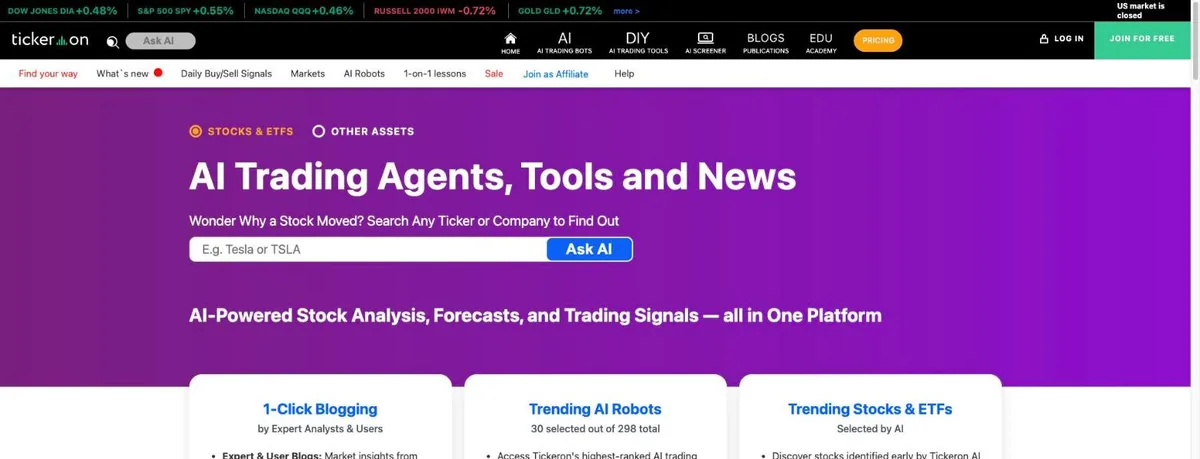
The homepage on October 7, 2026 led with "AI Trading Agents, Tools and News" and an Ask AI box that explains why a stock moved. Under it sit trending AI robots ("30 selected out of 298 total"), AI-selected stocks and ETFs, and a one-click blogging tool. It is busy, and Day Trading Toolkit's 5.5 out of 10 for ease of use feels generous for a first visit. The menu also carries a permanent "Sale" tab, which tells you something about how the pricing works.
Robots, agents and engines: a translation
Tickeron's vocabulary changes more often than its products, so here is what the main pieces do. The Pattern Search Engine scans charts for classic technical patterns (head and shoulders, triangles, flags) and attaches a confidence level based on how often that pattern has resolved as expected historically. The Trend Prediction Engine gives a directional forecast for a ticker with a stated probability. Daily Buy/Sell Signals are the cheapest product, a stream of swing-trade ideas.
The AI Robots, now marketed as AI Trading Agents, are the centrepiece. Each one runs a defined strategy on 5, 15 or 60-minute bars, using what Tickeron calls Financial Learning Models, and publishes its trades. Day Trading Toolkit counted more than 350 of them; the homepage said 298 when we checked. They come in three types. Signal Agents publish entries and exits without position sizing. Virtual Agents add money management, so their record reflects a simulated account. Brokerage Agents are tied to positions Tickeron says it holds in its own live brokerage account, and are the only ones whose trades you can, in limited cases, copy.
This is genuine machine-learning pattern work, and it puts Tickeron alongside Trade Ideas as one of only two tools in our trading bots guide where the AI produces trade ideas rather than helping you configure a bot. That deserves credit. It also needs a caveat. Pattern recognition finds shapes that have worked before; it does not know why they worked, and it cannot tell you when the reason has gone away.
The track records, and who wrote them
We did not subscribe and trade the robots for three months, because three months of one robot proves little. We read the homepage and robot pages on October 7, 2026, Liberated Stock Trader's February 2026 review and its September 2026 pricing guide, Day Trading Toolkit and Walnut's 2026 reviews, and all 28 Trustpilot reviews. The ranking reviews cover features and prices thoroughly. They mostly skip who wrote the performance numbers they quote, and one tells readers they need $25,000 to follow the day-trading robots, a rule that changed in June.
| Claim | Figure | Source of the number | Type |
|---|---|---|---|
| Pattern accuracy | 85 to 92% | Tickeron, as reported by Day Trading Toolkit | Backtested |
| "Day Trader Stock >$20" robot | 61.64% win rate | Tickeron, as reported by Liberated Stock Trader | Robot record |
| Range across 34 robots | 40 to 169% annualised | Tickeron, as reported by Liberated Stock Trader | Robot records |
| Trade signal quality score | 5.00 out of 5 | Liberated Stock Trader rating | Reviewer score |
| Independent audit of robot returns | None found |
Every performance number in that table starts with Tickeron. Liberated Stock Trader says Tickeron publishes its robot records trade by trade, which is more than many signal sellers do, and Day Trading Toolkit relays Tickeron's description of its AI Portfolios as "audited rather than backtested". Transparency is not the same as independence, though, and there is a selection effect built into the product: with roughly 300 robots running, some will always have spectacular records, and those are the ones that trend on the homepage.
Annualised returns are the figure to distrust most. A robot that makes 8 percent in its first two months can be shown as 50-plus percent annualised, and nothing about two good months says the next ten will look the same. When we see a range like 40 to 169 percent, we look for the start date before the number.
The same caution applies to win rates. A 61.64 percent win rate is plausible and, unlike the 95 percent figures elsewhere in this category, not obviously cherry-picked, but on its own it does not say whether the robot made money. That depends on the size of the average win against the average loss, and on costs. One Trustpilot reviewer's verdict on the signals was blunt: they "found no correlation to the success or failure of the underlying security". One reviewer is not a study either. The honest summary is that nobody outside Tickeron has published a test of whether these signals, followed by a real person with real fills, beat a simple index fund after fees.
Execution: you are still the one pressing buy
This is the biggest practical difference from StockHero or Trade Ideas. Day Trading Toolkit states that Tickeron's robots "do not currently connect directly to your live brokerage account for autonomous trading". For almost every user, a signal arrives, you check it, and you place the order at your own broker by hand. The Brokerage Agents, which copy Tickeron's own live positions, exist in limited availability. Liberated Stock Trader counted five broker connections and scored broker integration 0.5 out of 5.
That has an upside. Tickeron never holds your money, never needs API keys with trading permission, and cannot run away with your account. Your funds sit at your broker, with SIPC coverage, and nothing happens without you. The downside is speed. A signal on a 5-minute robot can be stale by the time you have read it, opened your broker and typed the order, which is why Day Trading Toolkit recommends Tickeron for multi-day swing trading rather than fast intraday work. Day-trading robots followed by hand will rarely get the robot's prices.
Pricing, the free tier and the trial
| Product | Promo price seen | List price reported | Annual | What you get |
|---|---|---|---|---|
| Free account | $0 | $0 | Portfolios, watchlists, alerts, basic AI ideas | |
| Daily Buy/Sell Signals | $5/mo | About $20/mo | Swing-trade signal stream | |
| Pattern Search Engine | About $30/mo | Real-time pattern scanning | ||
| AI Robots | $45/mo | About $83/mo | Access to robot signals at chosen timeframes | |
| Expert / AI Robots Unlimited | About $250/mo | About $125/mo | All robots, engines, backtesting, real-time data |
Tickeron does not publish a simple pricing page we could load; plans and prices appear inside the app and change with promotions. The figures above are from Liberated Stock Trader's pricing guide, updated September 2, 2026, and Day Trading Toolkit's 2026 review, and the promotional prices matched what our hub page recorded on October 6. Liberated Stock Trader's own advice is to check the checkout page before subscribing because the prices are promotional, and we agree. Intermediate bundles between the robot tier and Expert are reported at roughly $80 to $120 a month. Annual billing is reported to save around 50 percent.
Consider what that means for someone with an $8,000 swing-trading account who wants the robots. At the $45 promo, a year is $540, or 6.75 percent of the account. If the plan renews at the reported $83 list price, the second year is close to $1,000, about 12.5 percent. Expert on annual billing at roughly $125 a month is $1,500 a year, almost 19 percent of that account. The five-dollar signal tier, by contrast, is $60 a year and close to irrelevant against any account size, which is why it is the version we would start with.
The free account is genuinely free and worth opening before you pay anything: it lets you build portfolios, set alerts and see basic AI ideas. Day Trading Toolkit reports a 14-day trial for higher tiers, but it excludes the AI Robots, Expert membership and the Buy/Sell Signals, which are the three things you would want to test.
Billing complaints and other user reports
Trustpilot shows 3.4 out of 5 from 28 reviews, and the distribution is stark: 39 percent five-star, 7 percent four-star, 54 percent one-star. Trustpilot notes that Tickeron has not replied to negative reviews. The happy reviewers like the AI screener and the volume of robot signals. The unhappy ones are overwhelmingly about money rather than signals: auto-renewal they say they did not knowingly turn on, refunds refused, and charges after cancelling.
I cancelled my subscription within the time they allow, and then saw a $432 charge on my card.A one-star Tickeron reviewer on Trustpilot
Twenty-eight reviews is a small sample, and billing complaints are over-represented on any review site because angry customers write and content ones do not. Even so, among the three stock tools we cover, this is the worst billing record, and it should change how you subscribe. Use a card you can monitor, screenshot the plan and renewal terms at checkout, set a reminder before the renewal date, and cancel in writing with a saved confirmation.
The professional reviewers are kinder about the product and harsh about the platform. Liberated Stock Trader gave it a composite 4.19 out of 5 in February 2026, with 5.00 for signal quality but 0.77 for chart analysis, 1.88 for backtesting and 2.05 for scanning; it notes that you cannot plot your own indicators on the charts. Day Trading Toolkit scored it 7.4 out of 10 and listed app notification delays, crashes and battery drain. Walnut's review made the point we find most useful: predictive claims need "a long record net of costs before they mean anything".
Signals are not advice: the regulatory picture
Tickeron publishes the same signals to every subscriber and does not tailor them to your finances, so treat them as general research, not personal investment advice. We found no statement on its homepage that it is a registered investment adviser or broker-dealer. The robot pages do carry a risk disclosure: "Trading is risky and not suitable for every investor. Investors may lose all or more than the initial investment amount." That last clause matters, because several robot categories trade 2x and 3x leveraged ETFs and penny stocks. FINRA has warned for years that leveraged ETFs reset daily and can behave very differently from their underlying index over longer holding periods, which is a poor fit for a signal you may act on hours late.
The rule change that most affects Tickeron users is FINRA's. Liberated Stock Trader's February review tells readers to keep $25,000 or more in their account to comply with the pattern day trader rule. That was correct when written. The SEC approved FINRA's replacement on April 14, 2026, and from June 4, 2026 the $25,000 minimum and day-trade counting were replaced by intraday margin standards, with brokers given until October 20, 2027 to implement them. The notice is FINRA Regulatory Notice 26-10. Ask your broker which regime your account is on before following a day-trading robot.
Tickeron vs Trade Ideas vs StockHero
| Tickeron | Trade Ideas | StockHero | |
|---|---|---|---|
| Cheapest paid | $5/mo signals (promo) | $1,068/yr | $49.99/mo |
| Full product | About $250/mo; $125 on annual | $2,268/yr | $159.99/mo |
| AI type | Pattern recognition and signal robots | Overnight strategy selection | Mostly a label on rule bots |
| Places trades | Mostly no | Yes, on Premium | Yes |
| Assets | Stocks, ETFs, crypto, forex | US stocks and ETFs | US stocks; crypto via sister app |
| Trustpilot | 3.4 (28) | 3.8 (46) | 4.6 (19) |
The comparison mostly comes down to execution. If you want trades placed for you, StockHero automates your own rules and Trade Ideas automates a real signal engine at a far higher price. Tickeron is for people who want the ideas and are happy, or prefer, to place the trades themselves. It is also the only one of the three that covers crypto and forex in the same account.
Who it suits, and who should stay away
Tickeron suits a swing trader who holds positions for days, wants a second opinion from a model before buying, and will place orders personally. For that person the $5 signal tier is cheap enough to run alongside their own process for a few months as a test, logging every signal and what happened next. It also suits someone curious about how machine-learning signals behave who wants to learn without risking money: watch the robots on paper and compare their records with what you would have got.
Stay away if you want automation, because the robots mostly will not trade for you. Stay away if you day trade fast intraday moves, because manual execution will lag the signal. Stay away if you rely on charting, because the charts are among the weakest we have seen in a paid tool. And stay away, or at least subscribe very carefully, if auto-renewing subscriptions with strict refund terms have caught you out before.
Bottom line. Start with the free account, then the $5 signals. Only move to the robots once you have a log showing the signals are useful to you, and set a renewal reminder the day you pay.
Tickeron questions, answered plainly
Does Tickeron trade for me?
Mostly no. The robots publish signals and you place the orders. A brokerage-copying option exists in limited availability.
How much is it?
Signals from $5 a month and AI Robots from $45 a month on promotion, against list prices of about $20 and $83. Full access is about $250 a month, or $125 on annual.
Are the robot track records real?
They are published by Tickeron. Nobody independent has audited them, and annualised figures from short windows look bigger than they are.
Is there a free version?
A free account with portfolios, watchlists and basic AI ideas. The 14-day trial excludes the robots and signals.
Can I get a refund?
Assume not. Trustpilot's one-star reviews are mostly about renewals and refused refunds.
Is it investment advice?
No. The same signals go to every subscriber, and the risk disclosure says you can lose all of your investment.
Who is it for?
Swing traders who want model-generated ideas to check and execute themselves. Not people who want automation.
Verdict
Tickeron is a real machine-learning signal platform sold through a confusing storefront. The pattern tools and robots are interesting, the entry price is the lowest in our trading guide, and the multi-asset coverage is wide. The robots mostly do not execute, the performance records are Tickeron's own, the charting is poor, and more than half of its Trustpilot reviewers are angry about billing. As a five-dollar education in what AI signals look like, we would recommend it. As a trading system, we would not, and we would read the renewal terms twice before upgrading.