 By
By Risk note. Automated trading can lose money quickly, including on rules that looked sensible in a test. Coinrule places real orders on your exchange account. Nothing here is investment advice.
The friendliest way to automate your own logic, sold with the least consistent price list in the category. The if-then builder, the templates and the paper-trading exchange make Coinrule the best teacher here, and it never touches your funds. But the price depends on which page you read, the free plan stops at $3,000 a month, and real backtesting means a detour through TradingView.
- Best for
- Beginners and part-time traders who want to automate simple rules on an exchange they already use
- Skip if
- You need serious backtesting, you trade small balances on a monthly plan, or you want the bot to supply the strategy
- Price
- Free Starter; $29.99/mo shown, $359/yr; Pro listed at $749/mo
- Trustpilot
- 3.8 from 150 reviews; 9 in the last 12 months
What Coinrule is, and the people behind it
Coinrule is a London software company, Coinrule Ltd, founded by Gabriele Musella, Oleg Giberstein and Zdeněk Höfler. Its own About page says the product launched in March 2019; BeInCrypto dates the company to 2018 and SoftwareTestingHelp to 2017, describing it as crowdfunded with 11 to 50 staff. The About page lists early backing from angel investors and bank-linked advisers rather than a large venture round. The homepage claims "over 374,043 traders" and nearly 1.4 million strategies created, figures we cannot check and you should read as marketing.
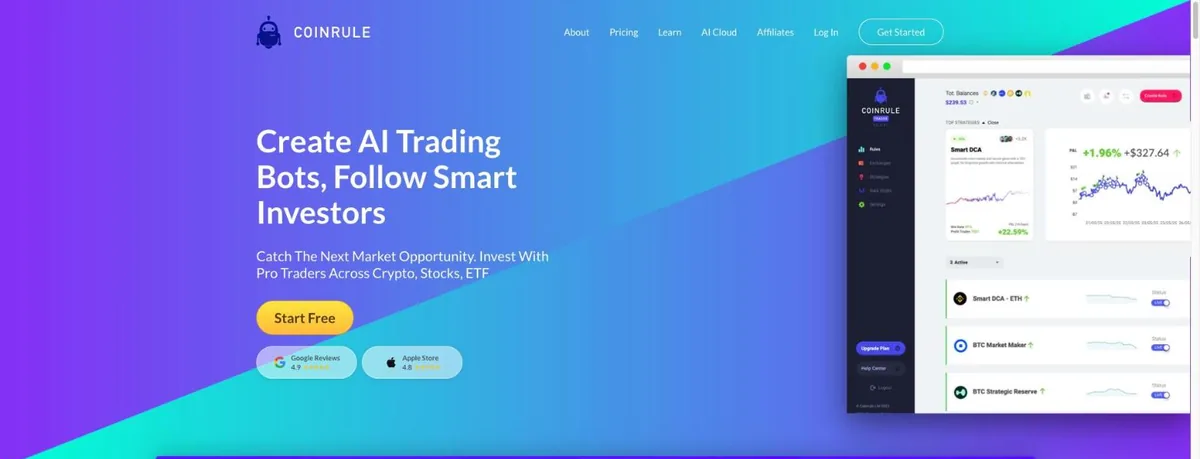
The product itself is simple to describe. You connect an exchange through an API key, then build rules out of blocks: a trigger (price moves, an indicator crosses, a TradingView alert fires, a time passes) and an action (buy, sell, notify). "If BTC drops 5 percent in 4 hours, buy $100 of ETH" is a complete strategy in Coinrule terms. Templates cover DCA, grids, scalping set-ups and an "any coin" scanner that applies one rule across the market. Coinrule runs the rule on its servers around the clock and places orders on your account. It never holds your coins.
Where this review's facts come from
We read Coinrule's homepage, pricing page and help centre on October 7, 2026, the App Store listing, the Trustpilot page by theme, and the four reviews that rank for the name: BeInCrypto, SoftwareTestingHelp, The College Investor and CoinCodeCap. They agree on the builder and disagree on almost every number, partly because some were written before the 2026 price changes. Two things they get wrong are worth flagging now. BeInCrypto and SoftwareTestingHelp both say there is no mobile app; there is one on iOS, rated 4.8 from 28 ratings. And none of them noticed that Coinrule's own homepage and pricing page disagree on the Pro price by $300 a month.
We spent longer on Coinrule's prices than on any feature, which is not how a review should go. But the price is the one thing a buyer needs to be certain of before entering a card, and here we could not be certain from the vendor's own site.
Rules, templates and the "AI" on the homepage
The builder is the reason to choose Coinrule. Every rule reads as a sentence, so you can show it to someone else and they understand what it will do. That is a bigger advantage than it sounds; most losses from bots come from settings the owner did not fully understand, and a grid bot's twelve parameters are harder to reason about than "sell if it falls 8 percent from where I bought". Order types, allocations, baskets and leveraged tokens are there when you outgrow the basics, and the Trader plan opens 150 templates to copy and edit.
Coinrule used to be refreshingly modest about AI. The homepage now says "Create AI Trading Bots", paid plans include an "Agentic Mode" and "Coinrule AI Cloud" with 500 to 50,000 AI credits depending on tier, and a Coinrule MCP connector lets ChatGPT, Claude, Gemini or Grok draft and manage strategies. CoinruleGPT, per the help centre, refines rule logic, checks condition and action blocks for errors, and converts rules to Pine Script. These are writing assistants for your rules. They are useful in the way a spell-checker is useful, and none of them forecasts prices.
So can Coinrule make you money? A rule does what it says, every time, without hesitation. If the rule has an edge, automation keeps it; if it does not, automation loses money faster and more consistently than you would by hand. Coinrule publishes no audited user returns, and the strategy tiles on its dashboard showing gains such as 22.59 percent are past results of selected rules. Past bot performance is not predictive.
Security, custody and the API key
Coinrule is non-custodial. Your funds stay on Binance, Coinbase Advanced, Kraken, OKX or wherever you trade, and Coinrule only receives an API key. Its connection guide is explicit that keys should not carry withdrawal or transfer rights, tells you to restrict the key to Coinrule's IP addresses, and says each user's key is encrypted and stored separately. SoftwareTestingHelp reports 256-bit AES encryption and Cloudflare in front of the platform. Two-factor authentication is available on the Coinrule account itself.
This applies to every API-based platform and bears repeating: Coinrule's servers hold a key that can trade your account. Create a dedicated key with trade permission only, never withdrawal, apply the IP whitelist from the connection guide, and keep only trading capital on that exchange. A 3Commas-style key leak, in which a trade-only key is abused, can still cost money through bad trades.
We found no reported breach or regulator action naming Coinrule in our research. That is an absence in the sources we read, not a certificate. One thing Coinrule does publish is a help article warning about scam sites impersonating it, so check the domain before you paste a key anywhere.
Pricing, as of October 7, 2026, from three sources
Here is the problem in one table. The pricing page lists monthly figures that match its annual totals divided by twelve, which suggests they are annual-billing prices shown per month. The App Store lists month-to-month in-app prices $10 and $20 higher. And the homepage lists Pro at $449.99 while the pricing page says $749.
| Plan | Pricing page, per month | Billed yearly | App Store, monthly | Live rules | Monthly volume cap | Exchanges |
|---|---|---|---|---|---|---|
| Starter | Free | Free | Free | 2 | $3,000 | 1 |
| Investor | $29.99 | $359 | $39.99 | 7 | $500,000 | 3 |
| Trader | $59.99 | $719 | $79.99 | 25 | $10M | 5 |
| Pro | $749 (homepage: $449.99) | $8,988 | Not listed | 50 | Unlimited | Unlimited |
| Business | Custom | |||||
The pricing page also says paid plans "cost only 0.02% of traded volume" compared with "a 1% fee on other trading bots". That is a marketing comparison, not an extra charge, and it only works out if you trade near the volume cap. Plans are "monthly rolling, cancel anytime"; we found no published refund policy. The College Investor's December 2025 snapshot listed $39.99, $79.99 and $499.99, so prices have clearly moved this year.
A worked example. You have $4,000 on Coinbase Advanced and Binance and want four rules: a weekly DCA into BTC, a dip-buy on ETH, and two take-profit rules. Starter fails on three counts (two rules, one exchange, $3,000 volume), so you need Investor. Paid yearly that is $359, or about 9 percent of the account every year before a single trade. Paid monthly through the app it is $39.99, or $480 a year, 12 percent. Exchange fees come on top; Coinrule's own demo assumes a 0.1 percent Binance fee, so $3,000 of monthly turnover adds about $3. The subscription, not the trading, is the cost that decides whether this works. Below roughly $10,000 we would stay on Starter and paper trade until a rule earns its keep.
Starter plan, demo exchange and the backtesting detour
The free Starter plan is genuinely free and genuinely limited: two live rules, one connected exchange, ten templates and $3,000 of monthly volume. Every plan includes the demo exchange, which paper trades against live Binance prices with a starting balance of 10 BTC and 10,000 USDT and a simulated 0.1 percent fee. It is the best learning sandbox among the tools we cover, because you can run the exact rule you would run live and watch what it does for a month with no money at risk.
Backtesting is weaker than the marketing implies. What the current help centre actually documents is a detour through TradingView: CoinruleGPT converts your rule to Pine Script, you paste it into TradingView, and TradingView runs the test. The guide adds that "you cannot backtest Coinrule's 'any coin'" rules this way, only specific pairs. The College Investor describes this as backtesting on every tier; since the AI credits that power CoinruleGPT are listed on paid plans, we could not confirm Starter users get the conversion. Either way, if testing a strategy across years of data is central to how you work, Cryptohopper does it inside the product.
Exchanges, stocks and the US position
The pricing page lists Binance, Coinbase Advanced, OKX, Kraken, KuCoin, Bybit and Bitget, and the homepage adds Hyperliquid and on-chain trading on Base, Arbitrum, Ethereum and BNB Chain. That on-chain support is new, and it means Coinrule is no longer a centralised-exchange-only tool. For stocks and ETFs, the homepage shows Trading 212, E*Trade, Webull, Public and Alpaca, but the help centre only documents Alpaca, with automated trading across Nasdaq stocks and stock paper trading.
For US users, Coinrule is usable because it is software rather than an exchange. The homepage states that "Coinrule is not a regulated financial institution and does not provide investment advice", and because it never holds funds it does not need the money-transmitter licences that Pionex has had trouble with. Your US access therefore follows your exchange: Coinbase Advanced and Kraken work for most states, while Binance's global platform is not for US residents. Stock rules on Alpaca run into the Pattern Day Trader rule, which Coinrule's help centre flags, so a US margin account under $25,000 cannot day trade freely however clever the rule. Taxes stay your problem; in the US every automated sale is a taxable event.
What users praise and what they report
Trustpilot shows 3.8 out of 5 from 150 reviews, 75 percent five-star and 13 percent one-star, but only nine reviews in the last twelve months, so most of that score describes an older product. Praise is consistent: easy to build rules, good learning material, quick support. The complaints are about reliability: rules that did not execute, a laggy web app, and repeated trouble with the OKX connection, plus some reports of slow support. Coinrule replies to every negative review and, unusually, disputes several, questioning whether the reviewer had an account or arguing they mistook a trading tool for a profit guarantee.
"super simple and easy to build rules to trade crypto" Coinrule user on Trustpilot
The homepage badges deserve a footnote. Google 4.9 rests on 388 reviews by Coinrule's own count, and App Store 4.8 rests on 28 ratings. Neither is fake. Neither is much of a sample.
Coinrule against Pionex, Bitsgap and Cryptohopper
| Coinrule | Pionex | Bitsgap | Cryptohopper | |
|---|---|---|---|---|
| Cheapest paid | $29.99/mo shown; $39.99 in app | No subscription, 0.05% fee | $29/mo, $23 annual | $29/mo, $24.16 annual |
| Free option | Starter, 2 rules, $3k volume | All bots free | 7-day trial, no card | 3-day trial |
| Who holds funds | Your exchange | Pionex | Your exchange | Your exchange |
| Strategy style | Plain-English rules | Preset bots | Grid, DCA, COMBO bots | Strategy designer, marketplace |
| Backtesting | Via TradingView export | Basic | Demo bots | Strong, built in |
| Stocks | Yes, via Alpaca | Tokenized only | No | No |
If you want bots with no subscription at all and accept custody risk, read our Pionex review. If you want a proper trial on your existing exchange, Bitsgap's seven days without a card beat Coinrule's capped Starter. The full field is in our AI trading bots comparison.
Who should use Coinrule, and who should not
Where the subscription is justified
- Rule builder anyone can read and audit
- Free demo exchange on every plan
- Non-custodial, trade-only keys, IP whitelist
- Crypto, DeFi venues and US stocks in one place
- TradingView alerts as triggers
- Cancel anytime, monthly rolling
Where it is not
- Three different price lists from one vendor
- Annual discount only visible against app prices
- $3,000 monthly cap makes Starter a sandbox
- No built-in backtester we could find
- Execution and OKX complaints on Trustpilot
- No published refund policy
Use it if you already have a few clear ideas about when to buy and sell, want them carried out without watching charts, and will spend a month on the demo exchange first. It is especially good for someone combining a crypto DCA plan with a few stock rules on Alpaca. Skip it if your account is small enough that $359 a year is a large slice of it, if you need deep historical testing before committing, or if you were hoping the AI would tell you what to trade. It will not. It will only do what you told it, very reliably.
Questions readers ask about Coinrule
What does Coinrule cost?
The pricing page shows $29.99 and $59.99 a month, or $359 and $719 a year. The App Store bills $39.99 and $79.99 month to month. Pro is $749 or $449.99 depending on the page.
Is the free plan usable?
For learning, yes: two live rules, one exchange, paper trading. The $3,000 monthly volume cap stops it being a real trading account.
Does Coinrule hold my money?
No. It trades through an API key on your exchange. Give the key trade permission only and whitelist Coinrule's IPs.
Can I backtest a rule?
Not inside Coinrule, as far as its help centre shows. You convert the rule to Pine Script and test it on TradingView, single pairs only.
Can I use it in the US?
Yes, through US-accessible exchanges such as Coinbase Advanced and Kraken, and Alpaca for stocks. Coinrule says it is not a regulated financial institution.
Is it actually AI?
The rules are plain logic you write. The AI parts help you write and check them. Nothing predicts the market for you.
Will it make money?
Only if your rules do, and past results do not predict future ones. Paper trade first and keep the subscription small relative to the account.
Verdict
Coinrule has the clearest strategy builder of any crypto bot we cover, a paper-trading exchange that makes learning cheap, and the right security model, because it never holds your money. It loses points for a price list that says three things at once, a free plan capped too low for real use, and backtesting that leaves the product. The AI on the homepage is a helpful writing aid for rules, nothing more. Start on Starter, run your rules on the demo exchange for a month, and pay for Investor on annual billing only once a rule has shown you it deserves the money.