 By
By Risk note. Automated crypto trading can lose money quickly, and futures bots can lose it faster. Bitsgap connects to real exchange accounts through API keys. Nothing on this page is investment advice, and no past bot result tells you what the next month will do.
The safest place to learn bot trading, and a pricey place to stay small. A no-card Pro trial, twenty demo bots and a clean security record make Bitsgap the gentlest start in the category. The catch is arithmetic: the features that keep a grid bot in play when the market trends live on the $69 plan, which is a heavy annual hurdle on a $3,000 account.
- Best for
- Cautious traders with $10,000 or more who want grid and DCA bots without writing a strategy
- Skip if
- Your account is under about $3,000, you need TradingView signals, or you want to design strategies from indicators
- Price
- $29/$69/$149 a month; $23/$55/$119 a month billed annually
- Exchanges
- 17 listed, non-custodial via API
Who is behind Bitsgap
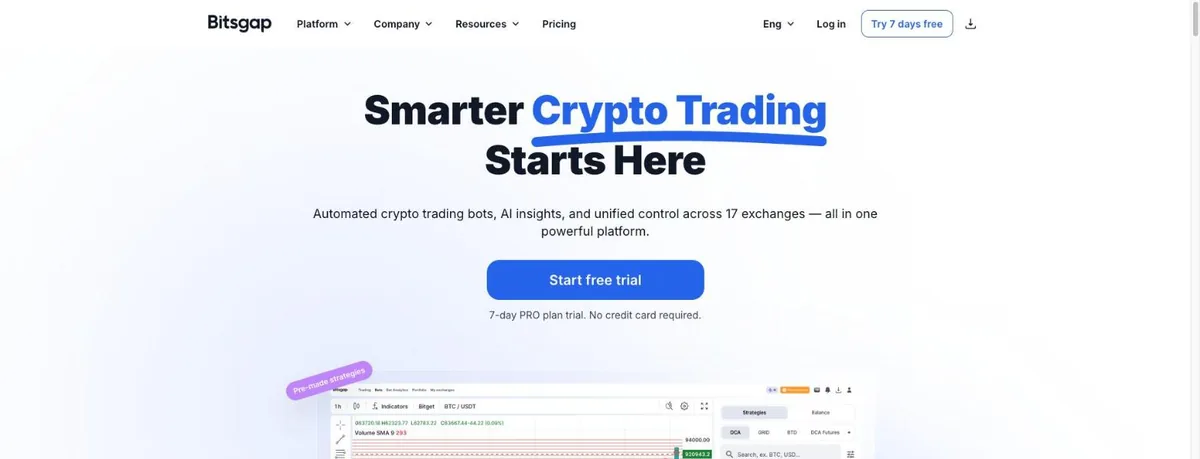
Bitsgap started life in 2016 as an arbitrage calculator, according to the timeline on its own team page, and became a cloud trading terminal with a grid bot in 2018 and 2019. Max Kalmykov is the founder and chief executive. The company took a seed round in September 2021 from Server Partners, amount undisclosed, and says it now has more than 100 staff. Its homepage claims 800,000 traders and 4.7 million bots launched. We cannot audit either number and neither can anyone else outside the company.
The corporate picture takes some reading. The terms of service name Bitsgap Software Solutions FZCO, registered in the Dubai Silicon Oasis free zone, with UAE law and UAE courts governing any dispute. The iPhone app is published by Bitsgap Holding OÜ, an Estonian company. Trustpilot lists an address in Tallinn. Not unusual for crypto software, but a formal complaint goes to a Dubai entity whose terms cap its liability at the lower of AED 5,000 or three months of fees.
What we checked, and what we could not
We read the pricing page and the plan cards with the monthly toggle on and off, the terms of service, the exchange-connection guide in the help centre, the iOS listing, and 652 Trustpilot reviews sorted by theme. We checked four ranking reviews against the vendor's current pages, and several were quoting 2024 bot limits that no longer apply. We also read the CFTC's 2024 advisory on AI trading bots, because it speaks directly to the kind of return figure Bitsgap puts on its homepage.
We did not run a live bot for a quarter and publish the result. One account's quarter tells you about that account and that quarter. What a buyer can actually verify is the price, the permissions, the record and the terms, so that is what we checked.
Six bots, an assistant, and the word "AI"
Bitsgap now lists six bot types, which is more than most reviews credit it with. The GRID bot is the original and still the reason people sign up: it lays a ladder of buy and sell orders inside a price range and collects small profits as the price oscillates. The DCA bot buys in steps as price falls and sells on a take-profit target. COMBO is a futures bot that mixes the two, with a trailing element. BTD (buy the dip), LOOP and QFL arrived more recently, the last two in 2024 and 2025 according to the company timeline. There is also a smart-order terminal for manual trades with trailing stops and take-profit levels across every connected exchange.
The "AI" is two things. An AI Assistant, on every paid plan, suggests bot settings for a pair based on recent volatility. On Pro, an "AI Portfolio Mode" spreads capital across bots. Neither is a model predicting prices, and we prefer that Bitsgap mostly does not pretend otherwise. One Trustpilot reviewer in January 2025 said the portfolio feature put everything into a single coin.
Backtesting depends on the plan: 30 days on Basic, 180 on Advanced, 365 on Pro. Thirty days is too short to see a grid bot live through a breakout, which is precisely the event that hurts grid bots most. If you are on Basic, lean on the demo bots instead.
Custody, API keys and what the bots can earn
Bitsgap never holds your coins. You create an API key on your exchange, paste it into Bitsgap, and its servers place orders on your behalf. The help centre asks for two permissions, trading and reading account data, and explicitly tells you to leave withdrawals off. That design matters more than any feature: if a bot platform is ever compromised, a trade-only key lets an attacker make bad trades on your account, which is painful, but not empty it to an outside wallet.
Set the key up properly before connecting anything. Trade and read only, withdrawals off, IP whitelisting on if your exchange supports it, and two-factor authentication on both the exchange and Bitsgap. Keep only the capital you intend to trade on that exchange.
On the record itself, Bitsgap claims "no hacks or breaches" since it launched, and we found nothing in the public record to contradict that. Compare 3Commas, whose leaked API keys in December 2022 are still in court; our 3Commas review covers that case. A clean history is not a guarantee. It is, in this category, a genuine point of difference.
Now the profitability question. The homepage advertises "$203M total one-year bot profit" and an "11% average 30-day return" for the grid bot. Those are vendor figures, unaudited, and an average across hundreds of thousands of bots tells you nothing about the distribution: the bots that were stopped at a loss, the ranges that broke, the accounts that quit. The CFTC's customer advisory on AI trading bots lists claims of 10 percent-plus monthly returns among the red flags it sees in fraud cases. Bitsgap is not making a guarantee, but that is the number range the regulator tells retail traders to be wary of.
"We shall not be liable for the results of using any bots offered via the Application." Bitsgap terms of service, read October 7, 2026.
What grid bots do well is harvest volatility inside a range. What they do badly is follow a trend: in a sharp rise they sell everything and sit in cash, and in a sharp fall they hold a growing bag of the coin. Trailing Up and Trailing Down, which move the range with the price, are the fixes, and they sit on the Advanced plan. Past performance of any bot, on Bitsgap or anywhere else, does not predict what it will do next month.
Exchanges, US access and the regulatory position
The homepage lists 17 exchanges: Asterdex, Binance, BitMart, Bitfinex, Bitget, Coinbase, Crypto.com, Evedex, HTX, Gate.io, Gemini, Kraken, KuCoin, OKX, Poloniex, WhiteBIT and Hyperliquid. The help centre also carries a setup guide for Binance.US, which is not on that list. For an American user, the realistic set is Coinbase, Kraken, Gemini, Crypto.com and Binance.US, and you should check each exchange's own terms for your state before funding it.
That has a knock-on effect people miss. Several of the newer venues on the list, including Evedex, Hyperliquid and Asterdex, are derivatives exchanges, and the COMBO bot is a futures bot. Most US residents cannot or should not be using offshore perpetual futures venues. So a US user is mostly buying the spot grid, DCA, BTD, LOOP and QFL bots, and the free plan (three COMBO bots on Evedex) is of little practical use to them.
As for Bitsgap itself, it is not registered with the SEC or CFTC as a broker or adviser and does not claim to be. Its terms say it operates under UAE law without needing a virtual-asset licence, and that it gives no trading advice. You are buying software; the exchange is the regulated party, to whatever extent it is. One more thing reviews rarely mention: in the US, every bot sell is a taxable disposal, and a busy grid bot can generate hundreds of them a month. Make sure your exchange exports clean trade history, or budget for crypto tax software.
Plans and prices as of October 7, 2026
| Plan | Monthly | Annual (per month) | Annual total | Grid / DCA / COMBO bots | Backtest |
|---|---|---|---|---|---|
| Free | $0 | $0 | $0 | 0 / 0 / 3 (Evedex only), 20 demo | None |
| Basic | $29 | $23 | $276 | 3 / 10 / 3 | 30 days |
| Advanced | $69 | $55 | $660 | 10 / 50 / 10 | 180 days |
| Pro | $149 | $119 | $1,428 | 50 / 250 / 50 | 365 days |
Annual billing saves 20 percent, which the plan cards put at $72, $168 and $360 a year. Every plan includes manual trading, smart orders, all 17 exchanges and chat support. Advanced adds futures bots, reinvesting bot profit and the trailing features. Pro adds take-profit controls on bots and the AI Portfolio Mode. Older reviews quoting two or five grid bots per tier are out of date.
Here is what that means for a realistic user. Say you have $4,000 on Kraken and want two spot grid bots on BTC and ETH plus a DCA bot on SOL. Basic covers that on paper, at $276 a year if you pay up front, which is 6.9 percent of the account before the bots earn anything. Pay monthly and it is $348, or 8.7 percent. Then the market trends, your BTC grid sells out at the top of its range and sits idle, and you realise you want Trailing Up. That is Advanced, at $660 a year, or 16.5 percent of $4,000. Add exchange trading fees on every grid fill, which on an active bot can rival the subscription. On a $20,000 account the same Advanced plan is 3.3 percent and a reasonable cost of doing business. Size the plan to the account, not the account to the plan.
The free plan, the trial and the demo bots
This is where Bitsgap is clearly better than its rivals. Sign up and you get seven days of the Pro plan with no card on file. When the trial ends, the account drops to the free plan automatically rather than charging you, which the pricing FAQ states in plain words and which we wish were standard. Cryptohopper's trial is three days.
The free plan itself is narrower than it sounds. Three COMBO bots on Evedex is a futures product on one exchange, and as covered above it is not much use to US traders or to anyone who wants spot bots. The real value is the 20 demo bots, which run on live market data with paper money. Several Trustpilot reviewers warn that demo results flattered them compared with live trading, mostly because demo fills ignore slippage and real exchange fees. Treat the demo as a way to learn the controls and watch a grid behave through a breakout, not as a forecast.
What users complain about
Trustpilot shows 4.0 out of 5 from 652 reviews, with 75 percent five-star and 13 percent one-star. Bitsgap replies to 57 percent of negative reviews and has no recent history of soliciting them, so we read the score as broadly organic. Capterra's 96 verified reviews average 4.6. The iPhone app has 4.3 stars, but from only 11 ratings in the US store, which is too few to mean much.
The praise is consistent: easy setup, a clean interface, the demo mode, and support staff named individually in review after review. The complaints cluster around five themes. Demo results that did not survive contact with a live account. API sync problems with connected exchanges. Profit and loss figures that users say did not match their exchange statements. Price, with one 2024 reviewer calling €50 for five grid bots "far too overpriced". And billing: a few Capterra reviewers say auto-renewal caught them out, and a January 2025 Trustpilot reviewer says a prorated refund was refused after cancellation. That matches the terms, which say fees are non-refundable unless Bitsgap itself ends the contract. Cancellation is in the account dashboard, not an email to support.
Why it is on our shortlist
- Seven-day Pro trial, no card, auto-downgrades to free
- Twenty demo bots on live data
- No publicly reported breach; trade-only keys
- 17 exchanges, including US-accessible majors
- Six bot types and a capable smart-order terminal
- Cancel from the dashboard
Why it might not suit you
- Trailing features locked to the $69 plan
- Only 30 days of backtesting on Basic
- No TradingView signal bots
- Free plan is futures-only, on one exchange
- No refunds on subscription fees
- Homepage return figures are unaudited
Bitsgap against 3Commas, Cryptohopper and Pionex
| Bitsgap | 3Commas | Cryptohopper | Pionex | |
|---|---|---|---|---|
| Cheapest paid | $29/mo; $23 annual | $20/mo list ($15 promo) | $29/mo; $24.16 annual | Free bots, trading fee |
| Trial | 7 days Pro, no card | Limited free | 3 days | Everything free |
| Custody | API keys | API keys | API keys | Exchange holds funds |
| TradingView signals | No | Yes | Yes | No |
| Backtesting | 30 to 365 days by plan | Limited | Strong | Basic |
| Security record | No public incident | 2022 API key leak | 2022 data breach, keys not taken | Regulatory questions |
3Commas does more, especially if TradingView alerts drive your trading, but carries the 2022 breach and a hollowed-out entry tier. Cryptohopper is for people who want to build and backtest strategies from indicators rather than pick a bot type, and its AI features cost $129 a month. Pionex is an exchange with free bots built in: no subscription, but Pionex holds your money. Our AI trading bots guide ranks all eight platforms side by side.
Who should sign up, and who should not
Sign up if you have never run a bot and want to learn on demo bots before risking a dollar, if your account is large enough that $660 a year is a few percent rather than a sixth of it, and if grid and DCA are the strategies you want. US traders on Coinbase, Kraken or Gemini will be well served by the spot side. Anyone wary of 3Commas' history will find the cleanest record in this group.
Skip it if your account is under about $3,000, because the subscription will eat a large share of whatever the bots make. Skip it if your entries come from TradingView alerts (3Commas), if you want to design indicator-based strategies and backtest them for years (Cryptohopper), or if you would rather pay nothing and accept an exchange holding your funds (Pionex). And skip any bot at all if you are hoping it will produce a monthly income. None of them can promise that.
Questions traders ask about Bitsgap
Is Bitsgap safe?
Non-custodial, no publicly reported breach, and keys need only trade and read rights. Turn withdrawals off and whitelist IPs where your exchange allows it.
Does it work in the US?
The software does. What you can trade depends on US-accessible exchanges such as Coinbase, Kraken and Gemini, and the futures bots are largely off the table.
What does it cost?
$29, $69 or $149 a month, or $23, $55 and $119 a month billed annually, as of October 7, 2026.
Is there a free plan?
Yes, but it is three COMBO bots on Evedex plus 20 demo bots. Fine for practice, no use for a spot grid on Coinbase.
Will a grid bot make money?
Sometimes, in sideways markets. Bitsgap's 11 percent 30-day average is a vendor figure, and past bot results do not predict future ones.
Can I get a refund?
The terms say fees are non-refundable. Cancel from the dashboard before the period renews.
Bitsgap or 3Commas?
Bitsgap for a cleaner record and a real trial. 3Commas if you need TradingView signals.
Verdict
Bitsgap gets the things that protect a beginner right: a trial that does not need your card, demo bots on live data, trade-only keys and a security history with nothing in it. It gets the pricing only half right, because the trailing features that make a grid bot survivable in a trending market are a $69 upgrade, and on a small account that turns a modest hurdle into a steep one. The homepage return figures are the weakest part of the pitch and the part we would ignore. Start on the demo, watch a grid bot get stranded by a breakout at least once, and only then decide if your account is big enough to make the subscription a rounding error.